

Why generic AI tools hit a wall in real industries
A generic AI assistant looks impressive in a demo. It answers almost any question, drafts almost any text, and seems ready for anything. Then a real industry puts it to work, and the cracks show fast.
The problem is that real industry work has rules a generic tool doesn't know. A healthcare task has compliance requirements. An insurance claim has a specific process. A property deal has documents that must be handled just so. A generic assistant treats these like any other question, and "mostly right" isn't good enough when an error costs a customer, a fine, or a failed audit.
A generic tool gives fast, broad answers. Real industry work often needs the right answer, in a specific process, every time.
This is why the market is shifting toward vertical agents, built for one industry rather than for everything at once.
Vertical vs generic: what's actually different
A generic, or horizontal, agent is built to work across every industry and task. It's broad and flexible, but shallow in any one area. A vertical agent is the opposite: built around a single industry, loaded with that field's data, rules, and workflows, and connected to the systems that industry runs on.
The difference shows in the hard cases. Ask both to draft a friendly email and they perform about the same. Ask them to process a regulated claim correctly, follow a compliance rule, or complete an industry-specific workflow end to end, and the generic tool guesses while the vertical one knows. Depth, not breadth, is what industry work rewards.
The real advantage isn't the model — it's the workflow
Here's the part most people get wrong. They assume a vertical agent wins because it runs a special, private AI model. That's rarely the real reason, and it's worth being clear about.
The underlying models are becoming a commodity. The big general models are powerful and available to everyone, so owning a slightly better one is not a lasting advantage. The real, durable edge is everything built around the model: the deep integrations into industry systems, the compliance rules, the proprietary data, and the workflow logic that completes a real task from start to finish.
The lasting advantage in vertical AI isn't the model. It's the industry workflow, integrations, and compliance built around it.
Even leading industry-specific AI companies now compete on workflow depth rather than a private model. That's the advantage: not the engine, but the industry-shaped machine around it.
Horizontal vs vertical: which fits which work
Neither type wins everywhere. They fit different work, and the honest answer usually uses both.
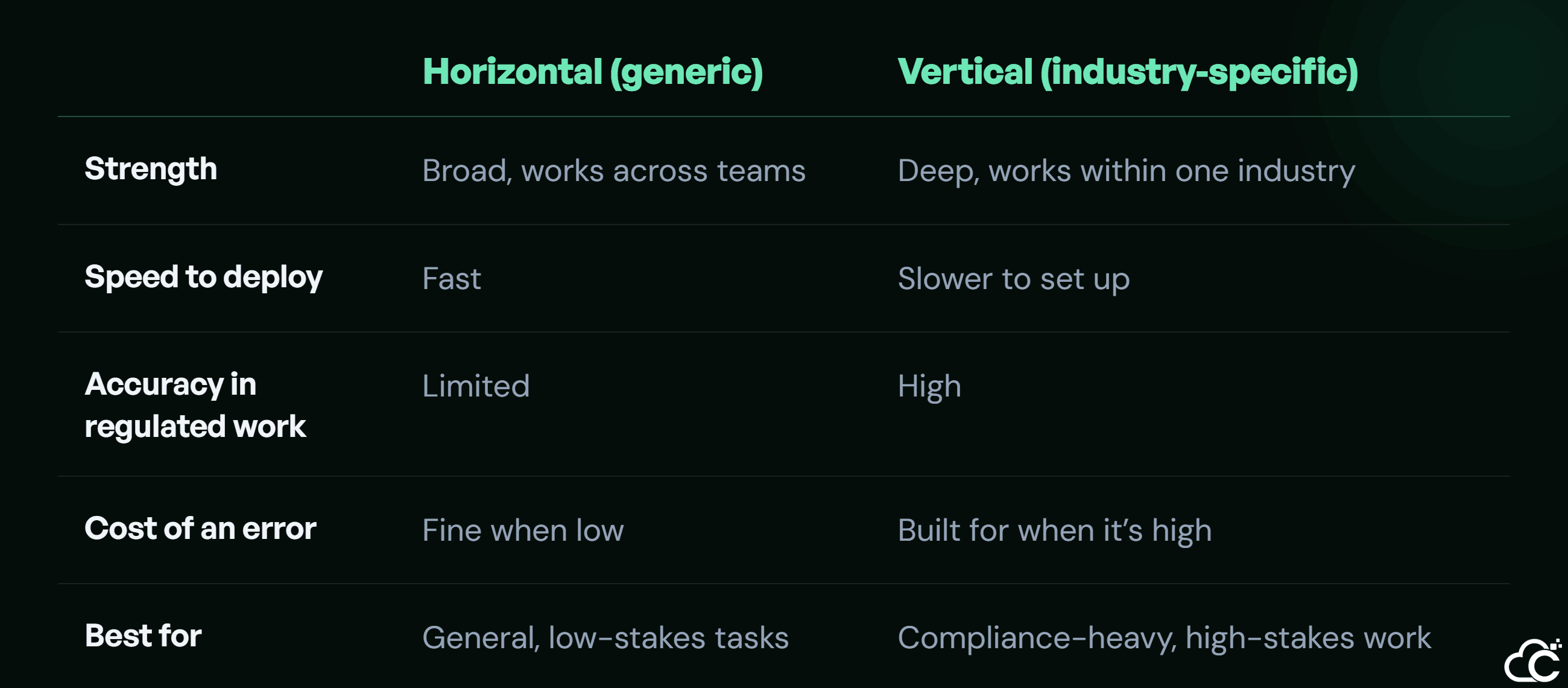
Read across and the rule is clear. Horizontal agents give you reach across many teams. Vertical agents give you depth and reliability in the work where mistakes are expensive.
What vertical AI looks like in practice
The vertical advantage is easiest to see in specific fields, and across industries AI is now delivering real, measured gains in revenue and cost. Here are four clear examples.
In healthcare, accuracy and compliance are non-negotiable, so a vertical agent handles patient data and clinical workflows with the safeguards a generic tool lacks. In insurance, claims and risk assessment follow strict, repeatable processes that a vertical agent can run consistently and audit cleanly. In retail and eCommerce, a vertical agent connects customer service with inventory, orders, and returns rather than answering in isolation. In real estate, the work is document-heavy and process-driven, exactly the structured, high-stakes workflow where a vertical agent built around the industry outperforms a general one.
The honest rule: when generic is actually fine
Vertical isn't always the answer, and pretending otherwise would be wrong. For plenty of work, a generic tool is the smarter, cheaper choice.
The simple test is the stakes. If a task has no regulator, no compliance requirement, and no real cost when it's occasionally wrong, a generic agent is fine and faster to deploy. Drafting internal notes, brainstorming, summarizing, answering broad questions: reach for the generic tool. Save the vertical agent for the work where accuracy, compliance, and process actually matter. Building a specialized agent for a low-stakes task is over-engineering, and it wastes money you didn't need to spend.
How to choose (and build) for your industry
Deciding comes down to the stakes of each workflow, not a company-wide rule. Map your work and the answer usually becomes clear.
For broad, low-stakes tasks, use a generic tool. For the regulated, high-stakes, industry-specific work where errors are costly, a custom agent built around your industry's workflow is worth the investment. And remember what you're really building: not just a model, but the integrations, compliance rules, and workflow logic that make it reliable in your field. Working out which of your workflows justify a vertical agent is the step that keeps you from over-building where a generic tool would do.
Conclusion
The move toward vertical AI agents in 2026 isn't hype against generic tools. It's a recognition that real industry work rewards depth, and that the lasting advantage is the workflow, compliance, and integrations built around the model, not the model itself. Generic tools remain the right choice for broad, low-stakes work. But where accuracy, regulation, and process matter, an agent built for your industry beats a general one every time. If you want help working out which of your workflows need a vertical agent and which don't, that's a conversation we're glad to have.

.png&w=3840&q=85)