

Why AI ROI is so hard to prove
Every board hearing about AI faces the same tension. Vendors quote returns that sound too good to be true, while the company's own pilots struggle to show a number finance will accept. So the board starts from doubt, and the person asking for AI budget has to overcome it.
That doubt is well earned. MIT's widely-cited 2025 research found that most enterprise AI pilots showed no measurable impact on profit, despite billions in spending. The striking part is that the failure is rarely the technology. It's that companies can't connect what the AI did to a number on the profit-and-loss statement.
The problem usually isn't that AI produced no value. It's that no one measured the value in a way finance would accept.
This is good news, in a way. A measurement problem is fixable. The rest of this guide is the framework for fixing it.
Start with the real cost (not just the license)
You can't prove a return without knowing the true cost, and most teams count only the obvious part. The license or usage fee is the visible cost. It's rarely the biggest one.
The full cost of an AI agent includes the build or setup work, the integration with your existing systems, the data preparation, and the ongoing monitoring and maintenance that never stops. Many teams price the first two and forget the rest, then wonder why the ROI never matches the forecast. Before you measure any return, get a clear view of what AI actually costs to run across its whole life, not just the first invoice. A return measured against half the cost isn't a return. It's a guess.
Turn indirect benefits into real money
Here's the insight that decides most AI business cases. Boards no longer accept "it saves time" as a result on its own, and they're right to push back. These indirect benefits — time saved, faster responses, fewer errors — only count when you turn them into money.
Saving an employee three hours a week is only worth something if you do something with those hours. If the person simply has a lighter week, the company's costs haven't changed and nothing reaches the profit line. The saving becomes real only when you act on it: redeploy the time to revenue-generating work, reduce headcount cost, or handle more volume without hiring. The same applies to every indirect benefit. Faster response times matter if they win or keep customers. Fewer errors matter if they cut real costs like rework, refunds, or penalties. Your job is to translate each one into a direct financial outcome: more revenue, lower cost, or avoided cost.
Hours saved are not money saved. They become money only when you turn them into revenue, lower cost, or more work done with the same team.
The metrics that actually matter
Once benefits are translated, track the metrics finance respects and drop the ones that just look busy. The difference is whether a metric links to money.
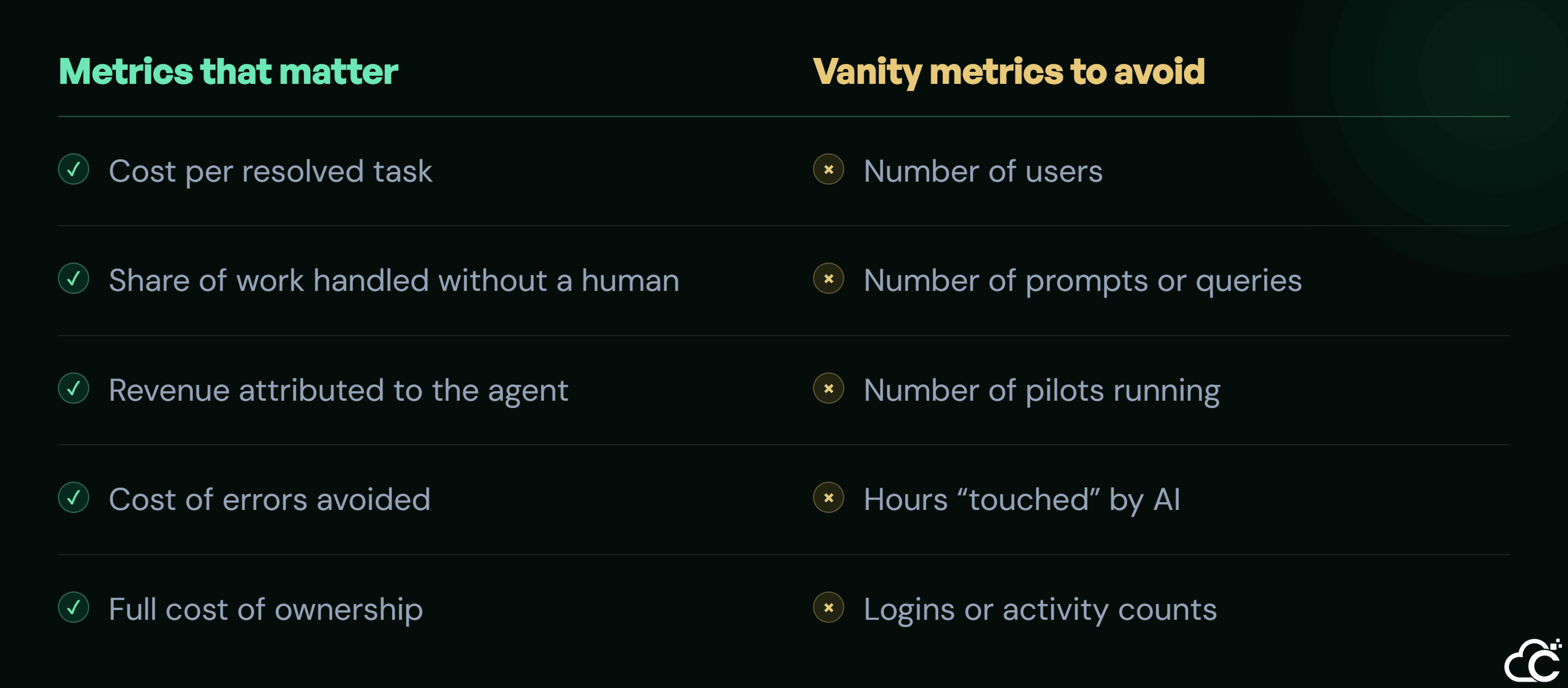
The left column ties to the profit-and-loss statement. The right column measures activity, not value, and it's where many AI dashboards go wrong. A system can show high usage and still deliver no financial return, which is exactly the trap the failed pilots fell into.
Measure against a baseline, per workflow
To prove improvement, you need something to compare against. That means measuring the workflow before the AI touches it, and doing it one workflow at a time.
Pick three to five priority workflows rather than trying to measure "AI across the company." For each, record the starting numbers before deployment: the cost per task, the time it takes, the error rate, and how often it needs a human. After the agent goes live, measure the same numbers. The difference, against the full cost, is your real return. Without that pre-launch baseline, any claim of improvement is unprovable, because you have nothing to measure it from. This per-workflow discipline is the heart of proving the value of automating a business process in a way a board can audit.
Decide when you'll stop before you begin
The habit that earns a CFO's trust is deciding, in advance, what result would make you stop. Most teams never do this, which is why weak projects drift on for months.
Before launch, set clear thresholds that trigger a review or a shutdown. An adoption floor: if fewer than a set share of users actually use it by a certain date, stop and look. An accuracy floor: if the agent's accuracy falls below a set level, fix it or halt. A cost ceiling: if the cost per task rises above the old manual cost, investigate. Committing to these upfront does two things. It stops good money following bad into a project that isn't working, and it shows the board you're treating AI as a disciplined investment, not an act of faith.
Building the business case
Put the pieces together and you have a business case that survives a board review. It rests on four honest foundations.
Model the full cost of ownership, not just the license. Translate every indirect benefit into revenue, lower cost, or avoided cost. Measure each workflow against a real pre-launch baseline. And decide your stop thresholds before you spend. Report the indirect benefits too, but label them clearly as indirect, so the hard numbers carry the case. A business case built this way doesn't need to oversell, because the numbers are defensible. That defensibility is what turns a skeptical board into an approving one, and it's the foundation for rolling AI out across the organization.
Conclusion
Measuring AI agent ROI in 2026 isn't about finding an impressive percentage. It's a discipline: model the full cost, translate indirect benefits into direct financial terms, measure each workflow against its baseline, and decide your stop thresholds before you begin. The companies seeing real returns aren't the ones with the best technology. They're the ones who measure it honestly enough to prove what's working and stop what isn't. If you want help building an AI business case your board will accept, that's a conversation we're glad to have.
.png&w=3840&q=85)

.png&w=3840&q=85)