

Why most retail data projects disappoint
A retail data modernization program usually ends the way it was supposed to. The migration completes on schedule. The new platform runs. The old systems are switched off. On paper, it worked. Then the merchandising team is still waiting days for demand signals, and the loyalty program is still running on last week's data.
This is the quiet disappointment at the heart of many retail data projects. The technology part succeeded, but the business still makes decisions at the same speed it always did. The program delivered new infrastructure without changing anything a customer or a store manager would notice. And when that happens, the cause almost always traces back to a single choice made before any data was moved.
Most retail data programs don't fail on technology. The platform works and the data moves. They fail because nobody decided, up front, what faster decision the whole effort was for.
Getting that one choice right is what separates a modernization that pays for itself from one that just relocates the same problems to the cloud.
The one decision that changes everything
The programs that deliver real results share one habit. Before any data is touched, they name a single business decision that needs faster or better data, and they build the entire scope around it.
That decision might be weekly replenishment planning, or how fast the business responds to a promotion across store clusters, or how quickly pricing reacts to changing inventory. It doesn't matter which one, as long as it's specific and it matters. Once chosen, that decision governs everything downstream: which data gets cleaned, which systems get migrated first, and what can safely wait. The scope stops being "modernize our data" and becomes "make this decision faster," which is a goal you can actually finish and measure.
Scope the program around one business decision, not around the whole data estate. The decision tells you what to clean, what to move, and what to leave for later.
Why "clean everything first" quietly fails
The instinct most teams follow is the opposite, and it's where programs stall. The standard playbook says to profile everything, clean everything, then migrate. In retail, that is a trap.
Retail data is vast and messy by nature. Inventory records drift out of accuracy. Customer records pile up duplicates across point-of-sale, e-commerce, and loyalty systems over years. Promotion logic lives in several systems that disagree about what was offered to whom. Trying to clean all of it before moving anything commits you to a multi-year data cleanup effort with nothing to show for it along the way. Worse, these projects stall the moment different teams compete over which data matters most, because without a single business goal, nobody can settle the argument. Cleaning everything sounds thorough. In practice, it's how modernization programs run out of budget and patience before delivering anything.
What to clean first (and what can wait)
Once you've scoped around one decision, the question of what to clean answers itself. The decision points directly at the few datasets it depends on, and those are the ones you clean and migrate first.
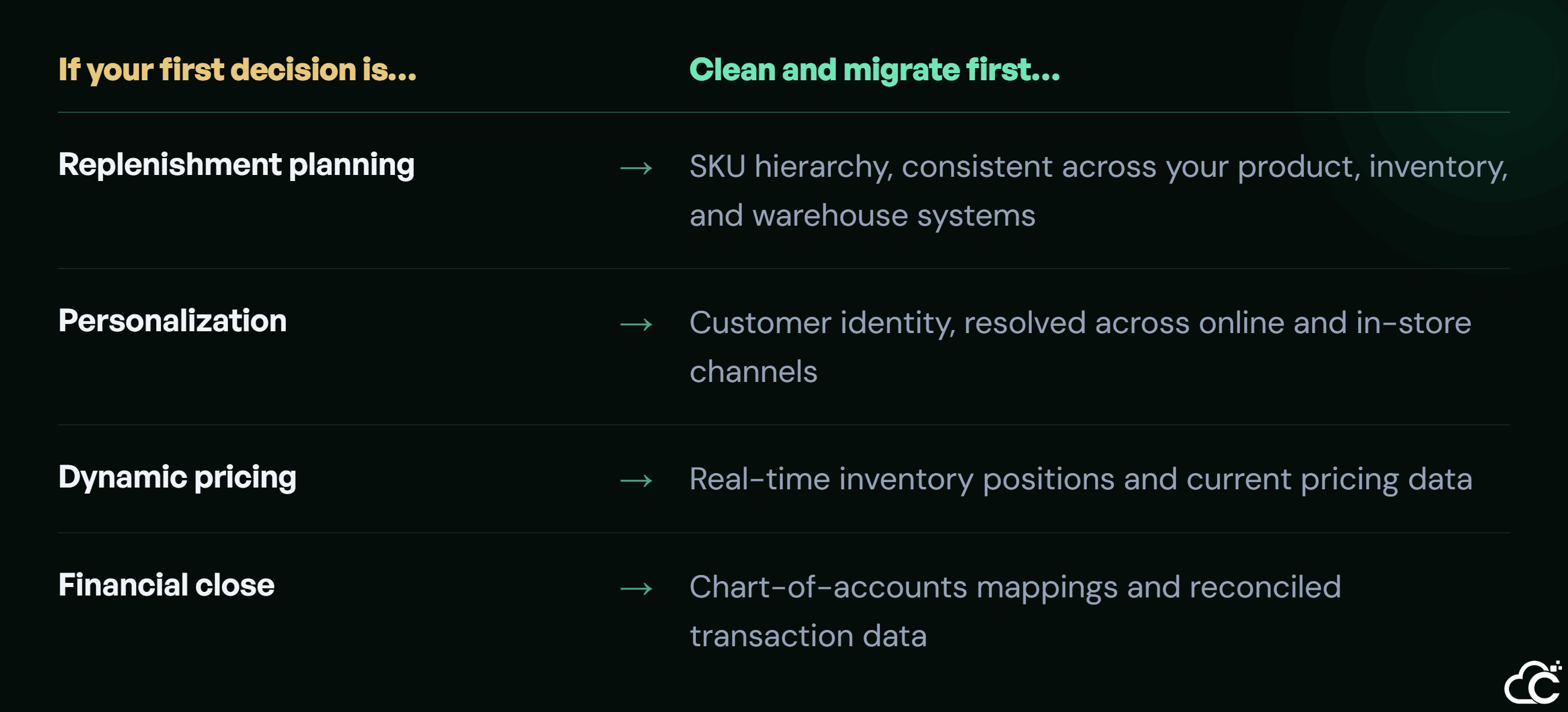
Everything else waits. The data that doesn't feed your first decision isn't thrown away. You simply deal with it later, when a future phase needs it. This focus is what makes the work finishable, and getting the data engineering to get this right on those few datasets matters far more than a shallow pass over everything.
Why AI-ready data is now the real goal
There's a deeper reason to modernize with focus, and it's about what the data has to do next. The point of modern retail data isn't tidier dashboards. It's feeding the real-time AI that retail now runs on.
Demand-sensing that adjusts replenishment on store-level signals, fulfillment that routes across channels in real time, reorder agents that act on live inventory: none of these can run on data refreshed overnight in a batch. They need current, connected, trusted data, and that's a different standard from what a nightly report needed. This is why data readiness has become the deciding factor in whether AI works at all. Gartner predicts that 60% of AI projects will be abandoned through 2026 where the data isn't AI-ready, and found that most organizations lack the data practices AI requires. Modernizing for AI-readiness, not just for a platform upgrade, is what keeps your program on the right side of that number.
Fund each phase with the last one's win
The scoped approach has one more advantage, and it changes how the whole program gets paid for. Because each phase delivers a real business outcome, each one can fund the next.
When your first decision delivers, whether that's faster replenishment or quicker promotional response, it frees up time, money, or both. That win becomes the case and the budget for the next phase. You deliver replenishment first, prove it, and use the value it created to fund the customer-identity work after it. This is the opposite of asking for a large budget upfront for a multi-year program with benefits promised at the end. It earns expansion instead of front-loading it, and it's why planning the migration in the right order matters as much as the migration itself.
How to scope your first decision
Turning this into action is straightforward once you accept the principle. You start small and specific, not big and comprehensive.
Name one decision your business makes too slowly today because the data is late or scattered. Map the three or four datasets that decision actually depends on. Clean and migrate those, and leave the rest for later. Then measure the thing that matters: whether that decision now happens faster. If it does, you have both a win and the funding case for the next phase. If you find yourself trying to scope around your whole data estate instead of one decision, that's the sign to narrow down before you spend anything.
Conclusion
Retail data modernization isn't really a technology decision, which is why so many technically successful programs disappoint. It's a scope decision, made before any data moves. The programs that change how fast a retail business runs are the ones that pick a single decision worth speeding up, clean and migrate only the data that decision needs, build toward AI-ready data rather than a plain platform swap, and fund each phase with the value the last one delivered. If you want help scoping a retail data modernization around the decision that would move your business most, that's a conversation we're glad to have.


.png&w=3840&q=85)