

Why your RPA bots keep breaking
If you run an RPA program, you know the pattern. A bot works perfectly for months. Then a vendor updates their portal, a button moves, a form gains a field, and the bot stops. Your team drops what it's doing and spends two days patching it. A few weeks later, a different system changes, and it happens again.
This isn't a sign your team built the bots badly. It's built into how RPA works. A robotic process automation bot follows a fixed script of clicks and keystrokes, tied to exactly where things sit on the screen. Move anything, and the script no longer matches. The result is a program that spends a large share of its time on maintenance instead of new work, and an automation team that feels more like a repair crew.
RPA does exactly what you told it, in exactly the order you told it. That's its strength on stable work, and its weakness the moment anything changes.
The honest fix isn't to throw out RPA. It's to understand where it still fits and where something better has arrived.
RPA isn't dead — but it hit its limit
The headlines say RPA is dead. That's an overstatement, and any automation lead can see through it. RPA still does one thing very well: it runs stable, structured, high-volume tasks cheaply and reliably.
If you have a process that never changes, on a system with a fixed screen, moving clean and predictable data, a well-built RPA bot is hard to beat. It's cheap to run and it does the job. The trouble is that fewer and fewer real business processes look like that. Most involve documents in varying formats, systems that update without warning, and exceptions that don't fit the script. RPA was built for a stable world, and most work isn't stable.
RPA optimizes the known and repetitive. AI agents handle the unknown and the variable. The skill is knowing which of your processes is which.
So the question isn't "RPA or agents?" as a company-wide choice. It's which of your specific processes each one suits.
What AI agents do that RPA can't
To decide what to migrate, it helps to know what an AI agent actually adds. Three capabilities separate an agent from a bot, and each maps to a place RPA struggles.
The first is reading unstructured data. A bot needs data in a fixed, predictable layout. An AI agent can read an email, a PDF, or a contract in a format it has never seen, understand it, and pull out what matters. The second is adapting to change. When a screen or a form changes, an agent works out what to do rather than stopping, because it interprets the goal instead of replaying fixed steps. The third is handling exceptions with judgment. Where a bot hits an unexpected case and halts, an agent can reason about it and decide the next step. Building the AI agents that handle this kind of work is what lets automation cover the messy, changeable processes RPA never could.
RPA vs AI agents: which fits which work
The two aren't rivals so much as tools for different jobs. Here's how they compare on the things that decide the choice.
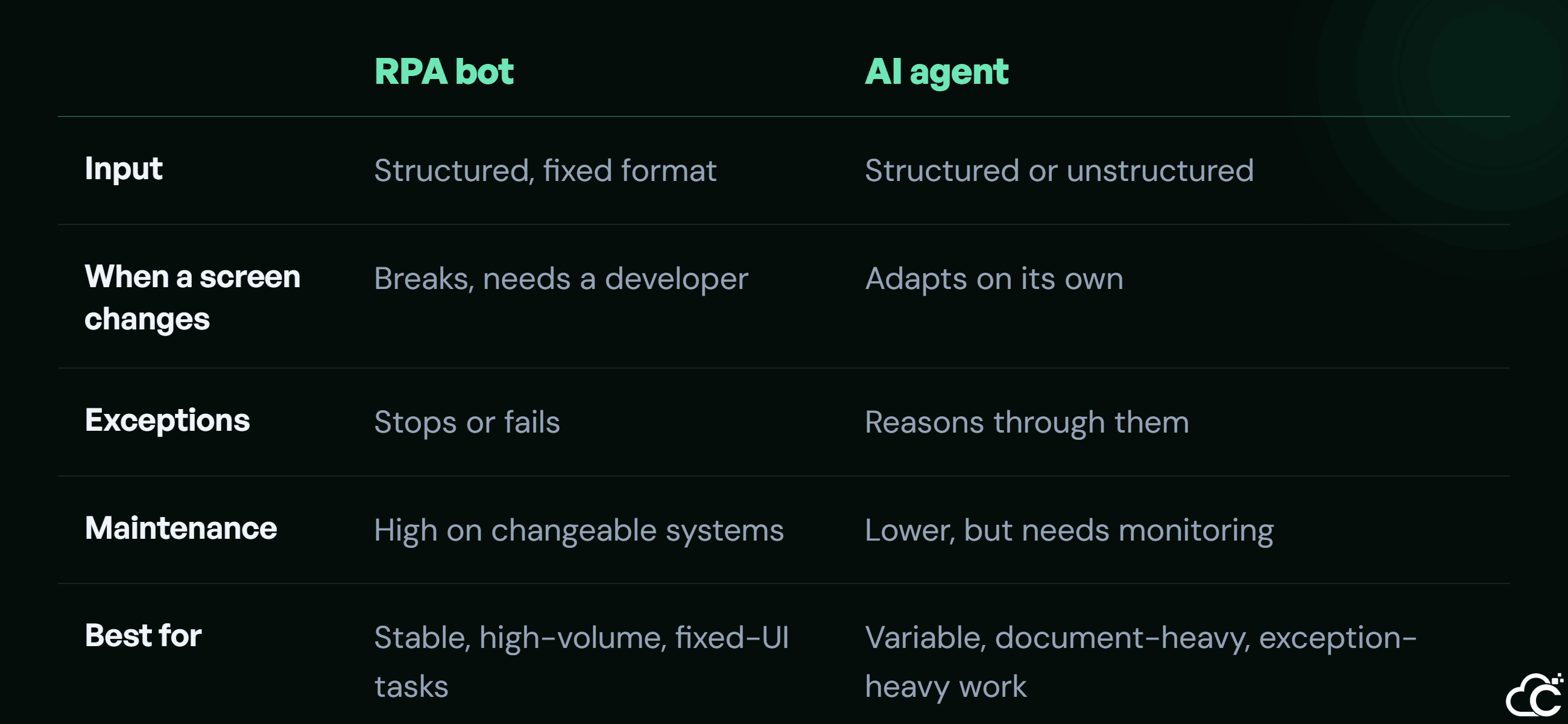
Read across and the split is clear. RPA is efficient where everything stays the same. Agents earn their place where inputs vary, screens change, or the work needs a decision. Most enterprises end up running both, matched to the work.
Which bots to keep, and which to replace
This is the decision that matters, and it's a bot-by-bot judgment, not an all-or-nothing switch. Sort your existing bots into two groups.
Keep the bots that are stable and cheap to run. If a bot works on a system that rarely changes, handles clean and structured data, and almost never needs patching, leave it alone. It's doing its job, and replacing it would spend money for no real gain. Replace the bots that keep costing you. The clearest candidates are the ones that break whenever a vendor changes a screen, the ones that need constant maintenance, and the ones that stall on documents or exceptions they can't handle. Those bots are where your team loses time and where an agent's ability to read, adapt, and reason pays for itself. Start your migration list with the bots that generate the most maintenance tickets.
How to migrate without breaking production
The most important rule of migration is the one teams most often ignore: don't rip and replace. Pulling out working automation all at once is how you cause outages and lose trust in the whole project.
The safe approach is to augment first, then replace. Pick the highest-maintenance bot on your list and build an agent for that one workflow.Then run the agent and the bot in parallel on the same live work for a set period, comparing their output, error rates, and speed. Only when the agent clearly matches or beats the bot do you switch over, and even then you keep the bot on standby for the first stretch. Repeat this for the next bot, and the next. Over a year to two years, the brittle bots get replaced while the stable ones keep running. This measured path is the heart of an automation strategy that fits your real workflows , and it's far safer than a single big cutover.
The goal isn't to replace RPA. It's to replace the bots that cost you the most, one at a time, without breaking what works.
Where this leaves your automation team
One worry comes up whenever this shift is discussed: what happens to the people who built and maintained the bots? The honest answer is that their work changes for the better.
When agents take over the brittle, high-maintenance bots, the team stops spending its weeks patching broken scripts. That freed time moves to higher-value work: designing new automation, handling the processes that were always too complex for RPA, and improving how the whole system runs. The role shifts from repair crew to automation designers. Modernizing the workflows behind your automation becomes something the team can finally focus on, instead of firefighting. It's a change in what the team does, not a reason to have fewer of them.
Conclusion
The move from RPA to AI agents in 2026 isn't the death of RPA, whatever the headlines say. It's a sorting exercise: keep the stable, structured bots that still do their job cheaply, and replace the brittle, high-maintenance ones with agents that can read, adapt, and reason. Do it in the right order, starting with the bots that cost you the most, running agents alongside them before cutting over, and retiring the old ones gradually. That honest, measured path gives you the resilience of agents without the risk of a big-bang switch. If you want help working out which of your bots to keep and which to migrate, that's a conversation we're glad to have.


.png&w=3840&q=85)