
The hidden cost of always using the biggest model
For the last few years, enterprises had one rule for AI: use the most powerful model available. When AI was new and usage was low, that was a reasonable choice. In 2026, it has become one of the largest sources of avoidable AI spending.
The reason is simple. A modern AI agent doesn't make one model call — it makes dozens per task, as it plans, uses tools, and checks its own work. When every one of those calls goes to a giant, expensive model, the cost adds up fast. Most of those calls are simple, repetitive steps that don't need a giant model at all.
Most enterprise AI work is narrow and repetitive — parsing, sorting, classifying, and formatting. Using a frontier model for those tasks is like hiring a surgeon to apply a bandage.
The fix isn't to abandon large models. It's to stop using them for jobs a smaller model does just as well for far less.
What a small language model actually is
A small language model, or SLM, is a compact AI model — usually under about 10 billion parameters — that runs quickly and cheaply, often on your own hardware. Parameters are roughly the model's internal dials; fewer of them means less compute, lower cost, and faster responses.
The trade is focus for size. A large model is a generalist trained to do almost anything. A small model is trained or fine-tuned for a narrower set of tasks, and within that narrow range it can match a much larger model. For a specific, well-defined job, that focus is an advantage, not a limitation.
Why smaller wins on most enterprise tasks
For the repetitive tasks that make up most enterprise AI work, small models win on four fronts that matter to a business.
Cost is the headline. NVIDIA research found that running a small model can be 10 to 30 times cheaper than a large one for the kind of narrow, repeated tasks agents perform. Speed is the second: smaller models respond faster, which matters for anything real-time. Privacy is the third: because a small model can run on your own servers, sensitive data never has to leave your systems. Control is the fourth: a model tuned on your data behaves more predictably on your tasks than a general model does.
A small model tuned for one job often beats a giant general model at that job — cheaper, faster, and on your own hardware.
SLM vs LLM: which fits which job
Neither type wins outright. They fit different work, and the honest answer is that you want both.
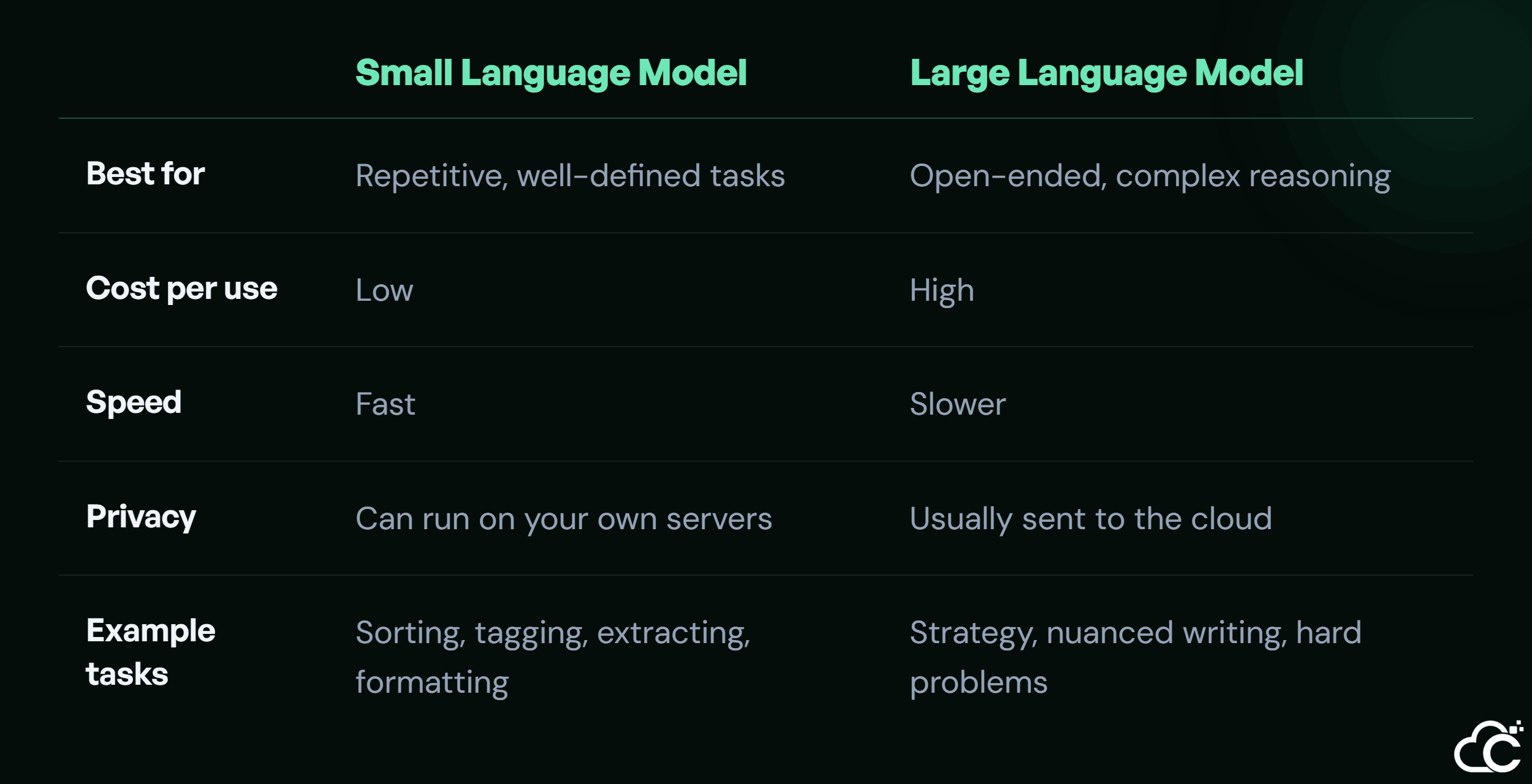
The pattern is clear once you see it this way. The small model handles the high-volume, predictable work. The large model is held in reserve for the genuinely hard problems where its extra capability earns its cost.
The winning pattern: SLM-first, LLM-on-demand
The best AI architecture in 2026 isn't small instead of large. It's small first, large when needed.
In practice, this means routing each task to the smallest model that can do it well, and escalating to a large model only when the task genuinely needs deeper reasoning. A routing layer checks each request and sends it to the right model — the cheap small one for routine steps, the expensive large one for the hard cases. Building the engineering to route between models is what turns this from an idea into real savings, and it's where most of the cost advantage is won or lost.
Where this is heading by 2027
The direction of travel is clear, even if exact numbers vary by source. Analysts expect specialized small models to take a growing majority of routine enterprise AI work over the next few years, with large models reserved for the harder minority of tasks.
Gartner predicts that enterprises will use small, task-specific models about three times more than general-purpose large models by 2027. The reason isn't that small models are suddenly smarter. It's that most business tasks are narrow enough that a focused model is the better economic and practical choice.
How to start right-sizing your models
You don't need to rebuild anything to begin. Start by looking at where your AI spend actually goes.
Audit your AI calls and find the high-volume, repetitive ones — the sorting, tagging, and formatting steps. Take one of those, test a small model on it, and measure the cost and quality against your current large model. If it holds up, you've cut that task's cost sharply with no loss. Keep your large model for the hard work. Expanding from one proven win is far safer than switching everything at once, and it's where a clear plan for which model fits where pays off.
Conclusion
Choosing the biggest model made sense when AI was new. In 2026, it's an expensive habit. Small language models now match large ones on the repetitive, well-defined tasks that make up most enterprise AI work, at a fraction of the cost and with real gains in speed and privacy. The smart move isn't to pick small over large — it's to match the model to the task, using small models by default and large ones only where they earn their cost. If you want help working out which of your AI tasks could move to smaller models, that's a conversation we're glad to have.

.png&w=3840&q=85)