

Why "copilot" and "agent" get mixed up
If the AI copilot vs AI agent question feels confusing, the vendors are partly to blame. Microsoft 365 Copilot now includes agents called Researcher and Analyst. GitHub Copilot has a "coding agent" that works on its own. So the product called Copilot now contains agents, and the name on the box no longer tells you what the tool does.
It goes further than naming. Gartner found that only about 130 of the thousands of vendors selling "agentic AI" offer the real thing. The rest are agent washing: renaming chatbots and simple automation as agents. Gartner also expects over 40% of agentic AI projects to be canceled by the end of 2027, often because teams bought the wrong kind of tool for the job.
The real difference between an AI copilot and an AI agent
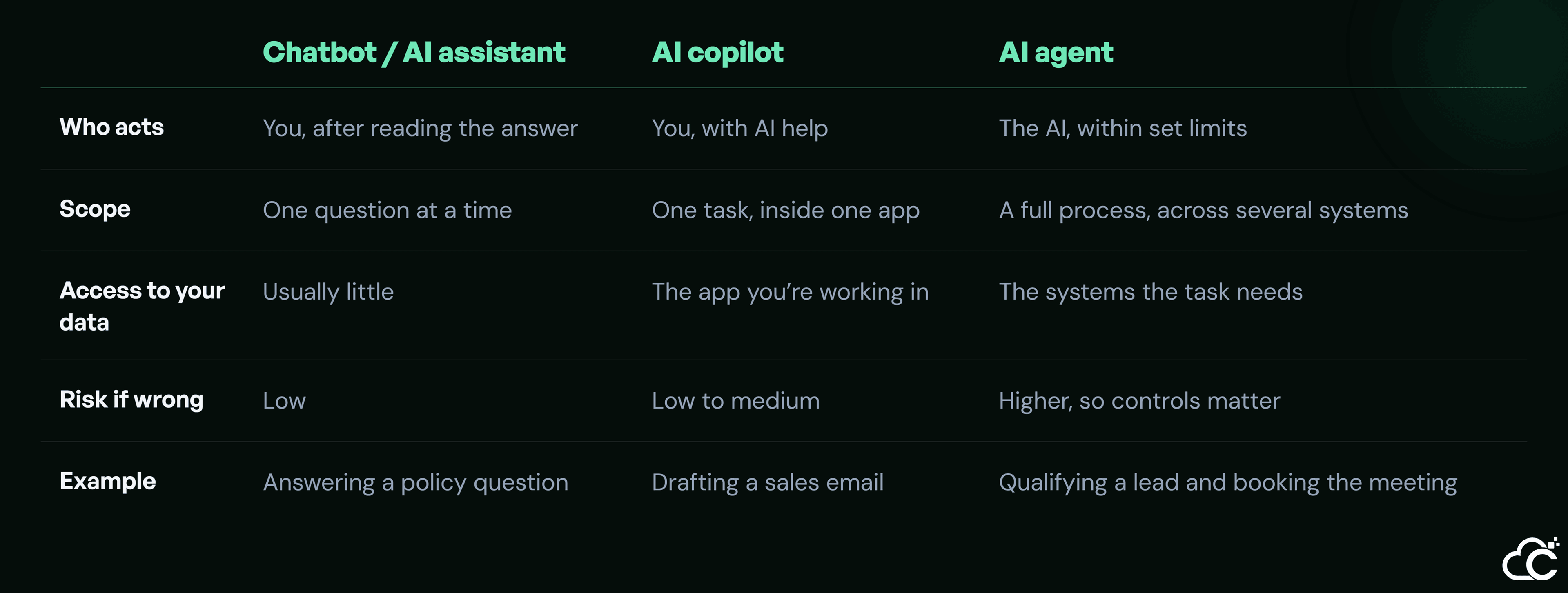
An AI copilot works with you. It drafts, summarizes, and suggests while you stay in charge, and you decide what happens next. An AI agent works for you. You give it a goal, and it plans the steps, uses your tools and data, and finishes the task, checking in with a person only when needed.
The easiest test is to ask who presses the final button. With a copilot, you do. With an agent, the software does, within limits you set. That one difference changes the risk, the setup, and the savings.
Where AI assistants and chatbots fit
The AI agent vs AI assistant difference is about action. An AI assistant or chatbot answers questions and gives information, but it doesn't carry out work in your systems. An AI agent can read data, make decisions, and take steps, like updating a record or sending a reply, to finish a task on its own.
This is why some tools are hard to label. ChatGPT is, at its core, a large language model that answers questions. But OpenAI has also added an agent mode that can browse websites and complete tasks. The same tool can be an assistant or an agent, depending on how it's set up.
You'll also hear assistive AI used for copilots and assistants, and agentic AI for agents. Assistive AI helps a person work faster. Agentic AI does the work itself. Both are useful. They just solve different problems.
Five problems where a copilot is enough
Many tasks don't need an agent at all. If a person should review the result anyway, a copilot gives you most of the value with far less risk.
1. Drafting emails and documents. A copilot writes the first draft, and you edit and send it.
2. Summarizing meetings. It turns a long call into notes and action items in seconds.
3. Writing and reviewing code. Developers accept or reject each suggestion, so they stay in control.
4. Answering research questions. It pulls facts from your documents, and a person checks them before using them.
5. Preparing for sales calls. It gathers account history and talking points, while the rep runs the call. For teams that want this inside their own tools, AI copilots built into the CRM your reps already use are often the quickest win.
How to choose: risk, volume, and human in the loop
Human in the loop AI means a person reviews or approves certain decisions before the AI acts on them. It's how you give an agent real work while keeping control of what matters. A good agent asks for approval on high-stakes steps, like payments or account changes, and handles routine steps on its own.
To decide between a copilot and an agent, ask three questions. How often does the task repeat? Does it span several systems? And what breaks if the AI gets it wrong? Frequent, multi-system tasks with clear rules suit an agent. Occasional or high-judgment tasks suit a copilot. When in doubt, start with a copilot, then let the task earn its way up to an agent.
The label on the box doesn't matter. What matters is who presses the final button.
Before you buy, test the vendor's claim. Ask what the tool does when nobody is watching. If the answer is "it suggests," you're looking at a copilot, whatever the label says. Getting a clear plan for which tasks get a copilot and which get an agent prevents paying agent prices for copilot work.
Conclusion
The AI copilot vs AI agent choice isn't about which technology is better. A copilot works alongside your people and keeps them in control. An agent takes whole tasks off their plate, inside limits you set. Most companies need both, matched to the right jobs. Sorting your own tasks into those two lists is the first real decision, so let's make it together before you spend a dollar on either.