

The choice every GenAI team faces
Every team building with AI hits the same question early on. The base model is good, but not quite right for your business. It doesn't know your private data, or it answers in the wrong tone, or it gets specialized questions wrong. So you need to customize it, and there are three ways to do that: prompt engineering, RAG, and fine-tuning.
Picking the wrong one is expensive. Teams routinely spend weeks and large budgets fine-tuning a model to fix a problem that better prompts or RAG would have solved in days, for a fraction of the cost. So the comparison that matters isn't "which is best?" It's "which one fits this specific problem?" The debate over RAG vs prompt engineering, and where fine-tuning fits, comes down to matching the method to the problem.
The three approaches aren't competitors. They solve genuinely different problems, and the skill is knowing which problem you actually have.
What each approach actually does
They work in completely different ways. Prompt engineering means writing better instructions for the AI, with clearer directions, examples, and formatting rules in the prompt itself. Nothing about the model changes; you're just asking better. RAG, short for retrieval-augmented generation, connects the AI to your data so it can look things up before answering, pulling in your documents, prices, or policies at the moment it responds. Fine-tuning retrains the model on your own examples, which changes the model itself so it behaves differently by default. In short: prompting changes the instructions, RAG changes what the AI can see, and fine-tuning changes the AI itself.
The one rule that makes this simple
If you remember one thing, make it this. The choice comes down to a single question: is your problem about knowledge or about behavior?
If the AI gives wrong or outdated answers because it doesn't know something, that's a knowledge problem, and the answer is RAG. If the AI knows the right answer but says it in the wrong format, tone, or style, that's a behavior problem, and the answer is fine-tuning. IBM's guidance frames it the same way: use RAG to give the model current and proprietary information, and use fine-tuning to shape how it performs a specialized task. The common and costly mistake is fine-tuning to fix a knowledge gap. Fine-tuning teaches the model a way of behaving, not a current set of facts, so using it to make the model "know" your data leads to confident wrong answers. Facts change; the model's trained weights don't.
RAG vs prompt engineering vs fine-tuning: side by side
Seeing the three next to each other makes the trade-offs clear.
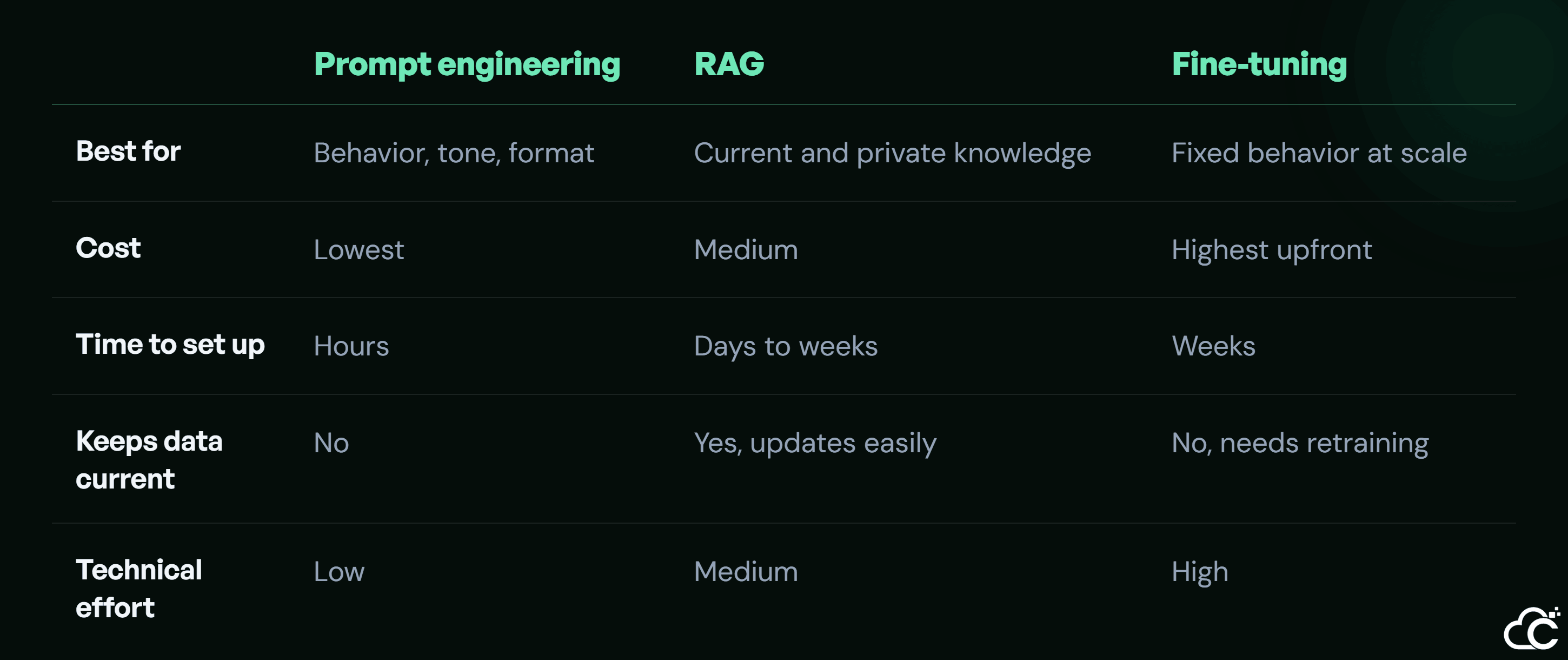
The pattern is clear. Prompt engineering is the cheapest and fastest but can't give the AI new knowledge. RAG keeps your AI current and is the workhorse for most enterprise needs. Fine-tuning is the most powerful for behavior but the most expensive and the hardest to keep up to date.
The order to try them in
The framework is also about the order to try them, because starting with the complex option wastes money. The sequence is simple: prompts first, then RAG, then fine-tuning.
Start with prompt engineering — it's free, fast, and most teams underinvest in it; a surprising number of problems disappear with clearer instructions and good examples. Move to RAG when the AI needs knowledge it doesn't have: your documents, your current data, your private information. For most enterprise projects, prompt engineering plus RAG is the complete answer. Reach for fine-tuning last, only when you've proven that prompts and RAG can't solve a behavior problem that persists at scale. Building the GenAI engineering to set this up correctly is far cheaper when you start simple and escalate only when the evidence demands it.
Why most real systems are hybrid
The smartest enterprise systems don't pick just one. The common pattern is RAG plus fine-tuning: fine-tune the model so it behaves correctly, with the right tone and format, and layer RAG on top so it always has current, accurate facts. The fine-tuned model handles how to respond; RAG handles what to respond with. This hybrid is increasingly the default for serious production systems, especially in high-stakes areas like customer support, legal, and healthcare, where you need both reliable behavior and up-to-date knowledge. Working out the right plan for customizing your enterprise AI usually ends here, with a combination matched to your actual problems.
Conclusion
Choosing between prompt engineering, RAG, and fine-tuning isn't about finding the "best" one. It's about matching each approach to the problem you actually have. Start with prompt engineering because it's cheap and fast. Add RAG when your AI needs current or private knowledge, which covers most enterprise cases. Reach for fine-tuning only when you need to fix how the AI behaves and the simpler options can't. And expect the strongest systems to be hybrids that use RAG for facts and fine-tuning for behavior. If you want help choosing the right approach for your own enterprise AI, that's a conversation we're glad to have.

.png&w=3840&q=85)