
Why teams start looking for Salesforce alternatives
Most teams don’t go looking for a Salesforce alternative on day one. They start on Salesforce or HubSpot, it works for a while, and then the friction builds. The per-seat bill climbs with every new hire. The team spends more and more time working around the system instead of with it. And eventually someone asks the obvious question: is there a better option than paying more every year for a tool that fits us less and less?
There are plenty of alternatives, from other suites like Zoho and Pipedrive to building your own. This guide focuses on the alternative that vendors never mention, because they can’t sell it to you: a custom CRM built around your business. It’s not the right answer for everyone, but for the right team it beats both Salesforce and HubSpot. The honest question isn’t “is custom better?” It’s “when does custom actually win, and when does buying the suite still make more sense?”
A custom CRM isn’t automatically better than Salesforce. It’s better in specific situations, and worse in others. Knowing which is yours is the whole decision.
When buying Salesforce or HubSpot still wins
Let’s start with the honest part that most “build your own” articles leave out. For a lot of teams, buying a suite is the right call, and building would be a mistake.
Buy the suite when your team is small, because at a handful of users, a monthly subscription is far cheaper than building and maintaining software. Buy when your sales process is standard, because Salesforce and HubSpot are built around common workflows and you’ll just be rebuilding what they already do well. Buy when you need it live fast, because a suite can be running in days while a custom build takes months. And buy when you don’t have anyone to own software long-term, because a custom CRM needs a person responsible for it. If several of those are true, stay on the suite. A custom build would cost more and deliver less.
When a custom CRM beats the suite
Now the other half. There are clear situations where a custom CRM genuinely wins, and they tend to share a shape: the suite is costing you more while fitting you less.
The first is team size and growth. Salesforce and HubSpot charge per seat, every month, forever, and that bill grows with every hire. A custom CRM is a one-time build you own, with no per-seat fee, so past a certain team size the economics flip. The second is unique workflows. If your process doesn’t map to the suite’s standard structure, you end up paying for expensive customization and workarounds, and a custom system built around your actual workflow is both cheaper and better. The third is data ownership and control, where regulation or strategy means you need your data and system on your own terms, not a vendor’s servers. The fourth is paying for a bloated tool you barely use, where you’re on an enterprise contract for a fraction of its features. If one or more of these clearly applies to you, it’s worth seriously looking at a custom CRM built around your business .
Salesforce and HubSpot vs a custom CRM: the honest comparison
Putting the options side by side makes the trade-offs clear.
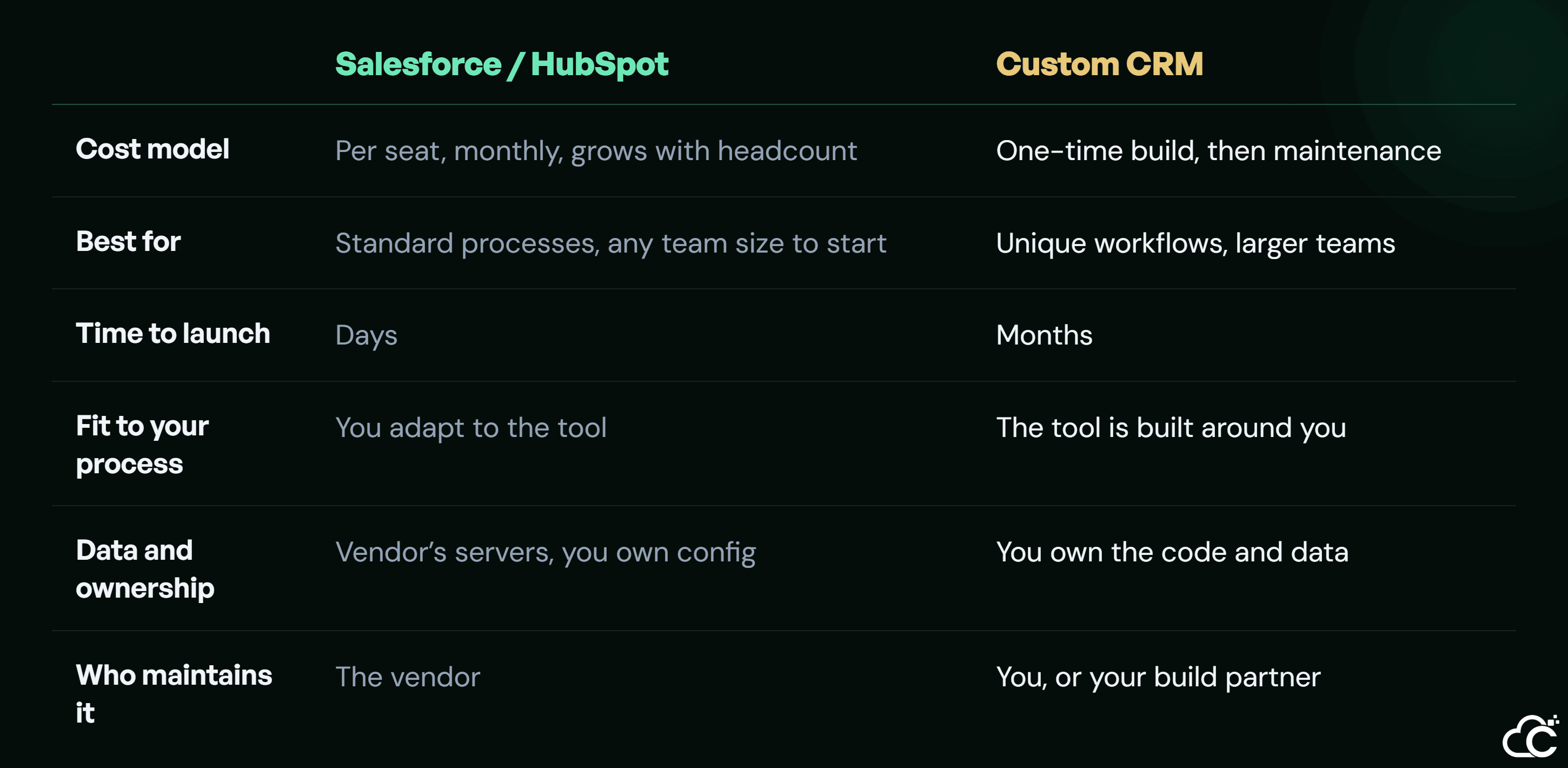
Read across and the pattern is clear. The suite is faster, cheaper at small scale, and maintained for you. A custom CRM fits you perfectly and stops charging per seat, but costs more upfront and needs an owner. Neither is better in the abstract; they fit different teams.
The real cost, and the break-even math
Here’s the number that actually decides it, and most comparisons get it wrong. The cost of a custom CRM isn’t just the build. It’s the build plus years of maintenance, and the honest comparison is your total multi-year cost of each option, not the headline price of either.
On the suite side, the published per-seat price is only the start. Salesforce’s own pricing runs from around $25 to several hundred dollars per user each month, and industry analysis, including Gartner’s, puts the real total cost of running it at roughly two to three times the license fee once you add implementation, admin, and add-ons. On the custom side, a mid-scope build typically runs tens of thousands up front, plus ongoing maintenance each year, but with no per-seat fee that grows as you hire. The break-even point, where custom becomes cheaper, commonly arrives for teams of around twenty or more users with specific workflows within roughly eighteen to thirty-six months. Below that, the suite usually wins on cost; above it, custom pulls ahead and keeps pulling ahead every year you grow. The way to decide is to run your own numbers: your true multi-year suite cost against a real build-plus-maintenance estimate. Doing that honestly is where expert help modernizing your CRM earns its place, because the answer is specific to your team, not a rule of thumb.
How to decide for your own team
The decision comes down to a short, honest checklist. Count your true multi-year cost on your current suite, including admin and add-ons, not just the seat price. Ask whether your process genuinely fits the suite or whether you’re constantly working around it. Ask whether your per-seat bill is growing faster than your revenue. And ask whether you have, or can get, someone to own a custom system. If the costs are high, the fit is poor, and you can support a build, custom is worth pricing out. If your process is standard and your team is small, stay on the suite. Most teams land clearly on one side once they do the real math, and engineering a custom CRM as a real product follows naturally from that honest answer. follows naturally from that honest answer.
Conclusion
The best Salesforce alternative isn’t the same for every team. For small teams with standard processes, staying on Salesforce or HubSpot is usually the smart, cheap choice. But for larger teams with unique workflows, growing per-seat bills, and a need to own their system, a custom CRM genuinely beats the suite, and keeps winning as you grow. The honest way to decide is to compare your real multi-year costs on each path, not to trust a vendor’s pitch or a “build your own” slogan. If you want help working out whether a custom CRM would actually beat Salesforce or HubSpot for your team, that’s a conversation we’re glad to have.