

Why choosing a cloud for AI got harder
A year ago, picking a cloud for AI was mostly about where you could find GPUs, the chips that power AI. Today, most of the work is running AI every day, not building it. That's why the AWS vs Cloudflare question keeps coming up. Are you paying big-cloud prices for work a cheaper network could do faster?
Deloitte expects about two-thirds of all AI computing in 2026 to go into inference, up from a third in 2023. Inference simply means an AI model answering a question. It happens millions of times a day, and each answer costs money. This guide compares AWS and Google Cloud with Cloudflare. Microsoft Azure works much like AWS and Google, so we focus on the bigger contrast: large clouds versus a fast global network.
The real difference between AWS and Cloudflare
AWS is a full cloud platform. It rents you servers, storage, databases, and AI tools from large data centers. Cloudflare started as a network that makes websites faster and safer. It now also runs apps, stores files, and runs AI models in data centers across more than 300 cities. Google Cloud works the same way as AWS.
For years, the two worked side by side. Companies ran their apps on AWS and used Cloudflare to speed them up and protect them. AI changed that. Cloudflare now runs AI models itself, so it competes for the part of your bill spent on answering AI requests.
Model choice: Bedrock vs Vertex AI vs Workers AI
Each cloud has its own AI service, and they don't offer the same models.
Amazon Bedrock is AWS's AI service. It offers Anthropic's Claude, Amazon's own Nova models, and, since June 2026, OpenAI's GPT-5.5.
Google Cloud folded Vertex AI into a new service, Gemini Enterprise Agent Platform, in April 2026, though most people still call it Vertex AI. It offers more than 200 models, including Google's Gemini and Claude.
Cloudflare Workers AI offers more than 50 open models, such as Llama and DeepSeek. Open models are free for anyone to use and run. For advanced models like Claude, Cloudflare's AI Gateway passes your request to the company that makes the model.
In the Bedrock vs Vertex AI choice, both are strong, so pick the one where your data and team already are. Cloudflare wins when an open model is good enough, and it often is for search, summaries, and chat.
Why AI inference at the edge is faster
AI inference at the edge means running an AI model in a data center close to the user, instead of in one far-away region. The request travels a shorter distance, so the answer starts sooner. Cloudflare works this way across its global network. AWS and Google Cloud usually run models in fewer, larger regions.
Picture a user in Vancouver using an AI model hosted in Virginia. Every request crosses the continent and back. For a chatbot, that's a small annoyance. For a voice assistant that has to reply mid-conversation, it can ruin the experience. That's why Cloudflare is often the best cloud for AI inference when your users are spread around the world.
It's also easy to use. There are no chips to manage, and you pay only for what you use. Workers AI gives you 10,000 free "Neurons" a day, its unit of AI usage, then charges $0.011 per 1,000. The catch is choice. You can only use the models Cloudflare offers.
Where to get GPUs and AI chips for training
Training means teaching an AI model using huge amounts of data. It takes thousands of chips running for days or weeks, and here AWS and Google Cloud lead. Both rent NVIDIA's newest GPUs, and both make their own AI chips. AWS released Trainium3 in December 2025. Google offers TPUs, and its two newest chips, TPU 8t and TPU 8i, are due later in 2026.
The TPU vs GPU for AI choice is mostly about flexibility versus cost. GPUs work with almost any AI software. TPUs and Trainium can cost less for big, steady jobs, but your team has to learn their tools. Cloudflare doesn't rent chips for training.
How egress fees add to your AI bill
Egress fees are what a cloud provider charges you to move data out of its network, to the internet or to another cloud. AWS charges about $0.09 per GB after the first 100 GB each month. Google Cloud charges about $0.12 per GB for most places. Cloudflare's R2 storage has zero egress fees, so moving data out is free.
That adds up. Sending 10 TB of data out in a month costs about $910 on AWS and about $1,140 on Google Cloud's default pricing. From Cloudflare R2, it costs nothing to move. Chatbot answers are small, so the real cost comes from moving big files, like training data, documents, images, and video. It hurts most when your data is in one cloud and your AI runs in another.
The cost of AI isn't only what you pay for each answer. It's also what you pay every time your data moves.
The fix is simple: decide where your data will live before you decide where your AI will run. Pipelines that put your data where your AI can use it often save more than any discount on AI prices.
AWS vs Google Cloud vs Cloudflare at a glance
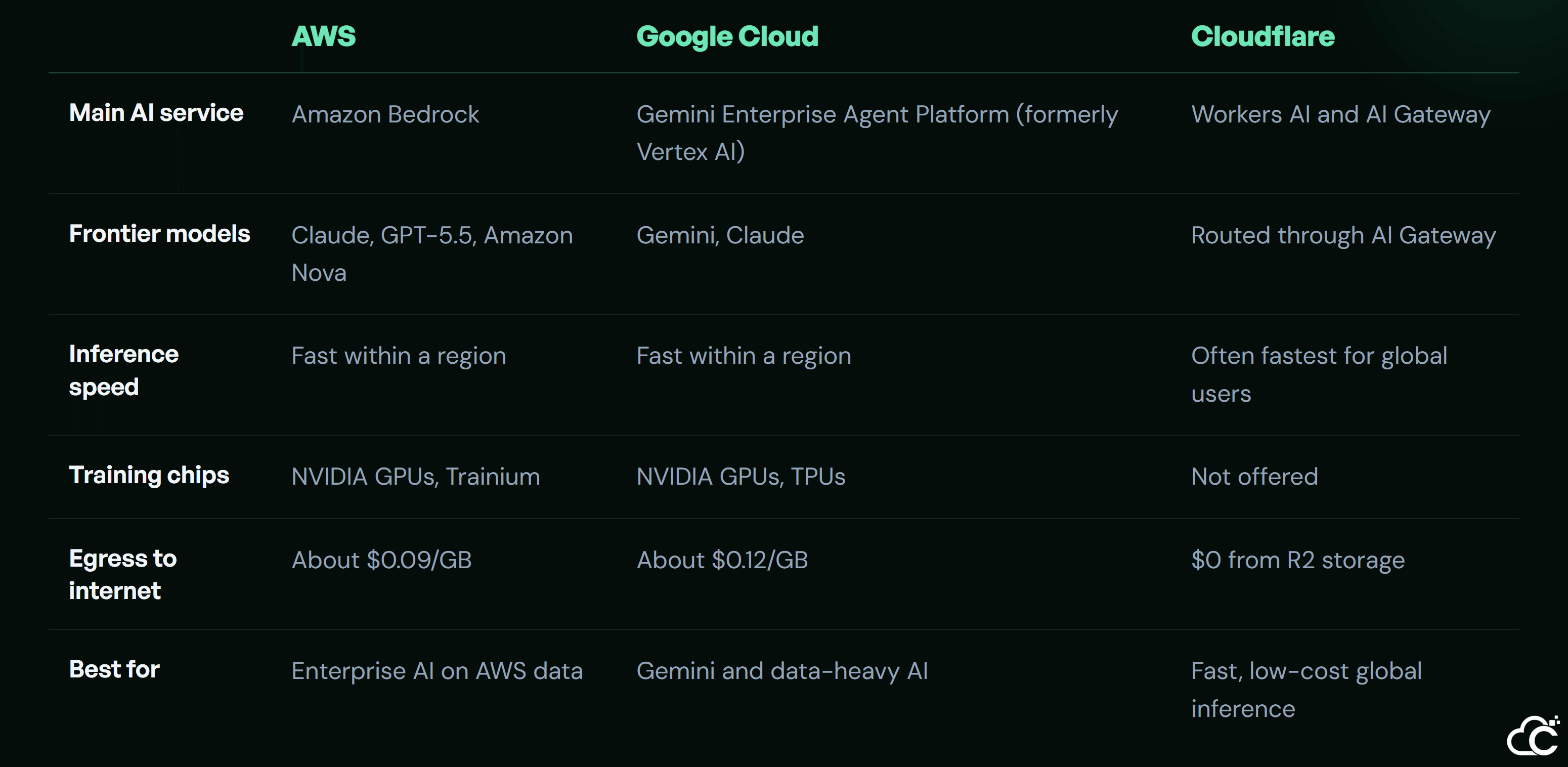
AWS and Google Cloud win on range. Cloudflare wins on speed and low data costs.
Which cloud fits each AI job
The best cloud for AI depends on the job. An AI assistant that uses company data should run where that data already lives, on AWS or Google Cloud. AI features for customers around the world suit Cloudflare, especially with open models. Training AI models belongs on AWS or Google Cloud. For sensitive data, like health records, start with where the data must stay. AWS and Google Cloud both offer services that support HIPAA.
For most companies, the answer is a mix. Keep data and training on AWS or Google Cloud, and serve answers from Cloudflare. A multi-cloud setup built around each workload also stops you from being stuck with one provider's prices.
The best cloud for AI is usually the one closest to your data for training, and closest to your users for answers.
Common mistakes when choosing an AI cloud
The first mistake is picking a cloud for its free credits, which run out in months while data fees last for years. The second is comparing AI prices and forgetting data fees, storage, and setup work. The third is building your product around one AI model company, so switching later means starting over. The last is moving your AI to a new cloud but leaving your data behind, so you pay a fee every time the two talk.
Conclusion
The AWS vs Cloudflare question has no single winner, and neither does the comparison with Google Cloud. AWS and Google Cloud are the right home for your data, the most advanced AI models, and training. Cloudflare is often the faster, cheaper way to deliver AI answers to your users. So don't ask which cloud is best. Ask which cloud is best for each job. If you'd like an independent review of which cloud fits each of your AI workloads, that's a conversation we're glad to have.