

Why more sales tools haven't meant more selling
Ask a sales leader to list their team's tools, and the list is usually long. A form tool, an enrichment tool, a CRM, a dialer, an email tool, a forecasting tool. Yet reps still copy data between them by hand. That's the problem a well-built RevOps tech stack is meant to solve. It isn't about owning more tools. It's about getting the ones you have to work together.
The numbers show how far most teams are from that. Salesforce's 2026 State of Sales report found that reps spend only about 40% of their time selling. The rest goes to admin, data entry, and chasing information. The same survey found that 51% of sales leaders using AI say disconnected systems are slowing them down.
RevOps automation fixes this by linking each tool into one flow, so data moves on its own from the first click to the final report. This guide breaks the sales tech stack into five layers. It shows what you can automate in each one today, and the order to do it in. How to structure the RevOps team itself is a topic for another day.
The five layers of a RevOps tech stack
A RevOps tech stack is the set of tools a company uses to find, win, and keep customers, connected so data flows between them. It has five layers. Capture brings leads in. Enrich adds missing details. Route sends each lead to the right rep. Engage handles outreach and follow-up. Report shows what's working.
Here's what each layer does, what you can automate in it today, and the warning sign that it's broken.
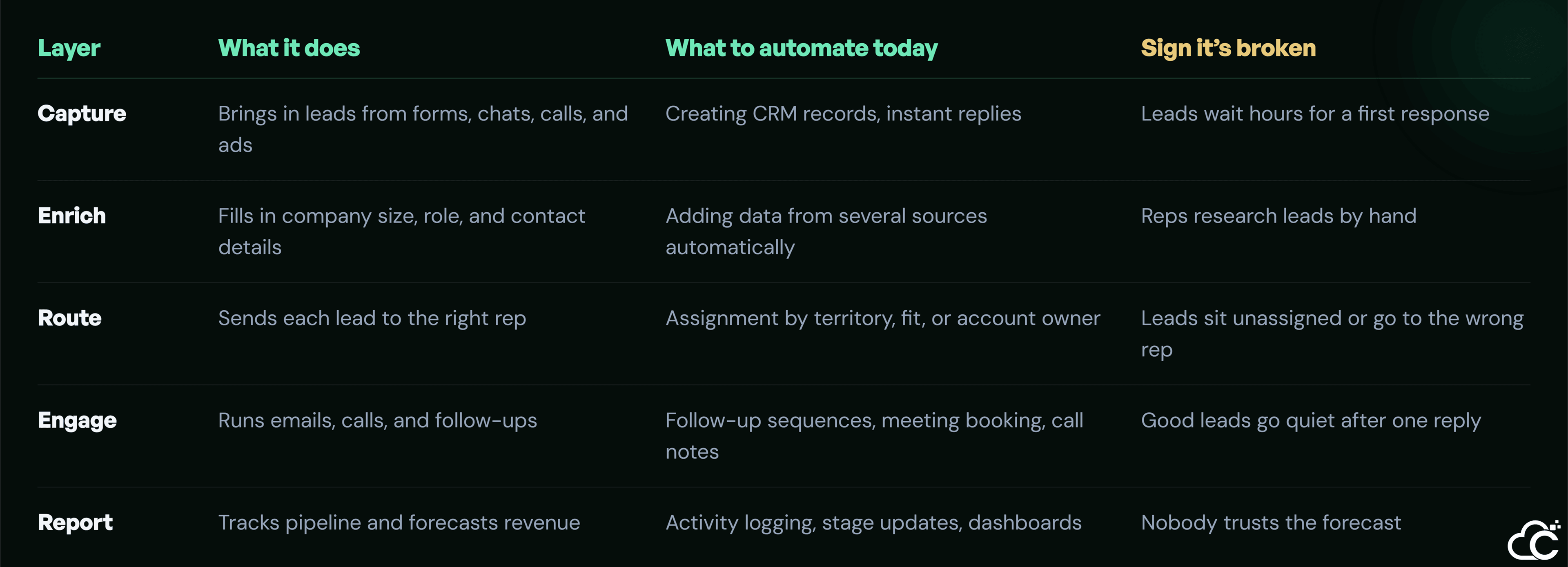
The layers work like a relay race. Each one hands its work to the next. If capture is slow, routing doesn't matter. If enrichment is missing, routing sends leads to the wrong person. That's why the order you automate in matters as much as the RevOps tools you choose.
Capture and enrich: getting clean data in
The capture layer is where speed starts. Every lead from a form, chat, phone call, or ad should land in your CRM within seconds, with the source attached. Lead capture automation does this without anyone typing. It also matters for a simple reason: speed to lead. A buyer who fills in a form is most interested in that moment. Every hour of silence gives a competitor the chance to reply first.
The enrich layer fills in what the lead didn't tell you. CRM data enrichment adds details like company size, industry, job title, and a working phone number. Reps no longer research every lead by hand, and the routing layer gets what it needs to make good decisions. Many CRMs now do some of this on their own. HubSpot, for example, has built enrichment into its platform after buying Clearbit.
Waterfall enrichment means checking several data providers in a set order until one returns the missing detail. If the first source has no phone number, the system tries the second, then the third. It fills more records than any single provider can, and many tools charge only when a provider finds a match.
Route and engage: getting every lead to the right rep fast
Routing is where many good leads get lost. Without rules, leads sit in a shared inbox, land with the wrong rep, or get worked by two reps at once. Lead routing software fixes this by assigning each lead the moment it arrives. It can route by territory, company size, product interest, or an existing account owner. It also spreads leads fairly across the team and skips reps who are out that day.
The engage layer handles the outreach. Sales engagement tools run follow-up sequences, book meetings, log calls, and remind reps when a deal goes quiet. Automated sales follow-up is often where teams see the fastest results, because it's the task reps skip most. Setting up follow-ups and lead routing that run inside the CRM your team already uses is usually the first quick win.
These two layers are also merging. In late 2025, Salesloft, a sales engagement tool, merged with Clari, a forecasting tool. The line between "engage" and "report" is getting thinner. For buyers, that means fewer tools to connect, but also a bigger cost if you pick the wrong platform.
Report: pipeline hygiene and forecasts you can trust
Pipeline hygiene means keeping deal data in your CRM complete, current, and accurate. That includes up-to-date stages, close dates, amounts, and next steps. When pipeline hygiene slips, forecasts drift and managers stop trusting the numbers. Automation keeps it clean by logging activity and updating fields without relying on reps.
Clean data is what separates the best teams. In the same Salesforce report, 79% of high-performing sales teams said they prioritize CRM data hygiene, compared with 54% of underperformers. Strong teams treat clean data as part of the job, not a cleanup project once a quarter.
A forecast is only as good as the data underneath it.
With clean data in place, reporting can mostly run itself. Activity logs, stage changes, and weekly pipeline reports build without manual exports. Forecasting tools can then spot risky deals early, because they're working from facts instead of guesses.
What to automate first, and where AI fits
Start at the top of the stack and work down. Fix capture and enrich first, because every other layer depends on them. Then automate routing, then engagement, then reporting. Before you buy anything new, try connecting the tools you already have so data moves on its own.
AI belongs at the end of that list, not the start. Gartner predicts that AI agents will outnumber sellers 10 to 1 by 2028. Yet fewer than 40% of sellers will say those agents made them more productive. The reason is simple. In Gartner's words, if your systems are fragmented, "the agents will scale the fragmentation." AI for RevOps pays off when the layers under it are already clean and connected.
Automate the foundation first. AI only multiplies what's already there.
Here's how this looks in practice. A SaaS company with free trials might create a CRM record for each sign-up and enrich it with company size. High-fit trials then go to a rep within minutes, and a follow-up sequence starts on its own. An eCommerce brand that sells wholesale might route store inquiries by region and send reorder reminders on a schedule.
In both cases, the biggest mistakes are the same. Teams buy tools before fixing the data, automate a broken process, or let each department set up its own tools. Some teams eventually move to a CRM that runs these layers itself, built around how they sell.
Conclusion
A RevOps tech stack works best as five connected layers, not a pile of tools. Capture and enrich bring clean data in. Route and engage turn it into conversations. Report tells you what's working. Automate them in that order, keep your data clean, and add AI only once the foundation holds. The teams that do this give their reps back hours of selling time every week. To find out where your own team is losing those hours, we'll pinpoint the layer that's slowing things down and automate it first.