

Why RAG demos work and RAG products don't
Every engineer who has built a RAG prototype knows the feeling. You drop in a few documents, wire up a vector store, pass the retrieved text to a model, and the answers look sharp. Then you ship it to real users, and the complaints start within a week.
Small problems that hide in a demo turn into real failures under real traffic. A slightly wrong chunk, a slow lookup, an answer confidently drawn from the wrong document — and the system loses trust faster than it earns it. RAG, short for retrieval-augmented generation, is the standard way to ground a model in your own data. Getting it to demo is easy. Getting it to hold up in production is an engineering discipline, and that's what this guide is about.
The real bottleneck is retrieval, not the model
Most teams debugging a bad RAG system look in the wrong place. They tune the prompt, swap the model, adjust settings — and the problem persists, because it lives upstream.
The model often isn't hallucinating. It's answering correctly from the wrong documents.
A naive RAG pipeline fetches the wrong context a large share of the time. When retrieval hands the model irrelevant passages, the model does exactly what it should: it writes a fluent, confident answer grounded in bad source material. The output looks trustworthy and is wrong. Once you accept that retrieval is the bottleneck, you fix the right layer — and nearly every high-impact improvement below lives in retrieval, not generation.
Fix the foundation first: ingestion and chunking
Before any clever retrieval trick, look at how documents enter the system. This is the least glamorous part of RAG and the most consequential.
Chunking means splitting source documents into smaller passages to store and search. Do it badly and everything above it suffers. If you cut sentences in half or mix unrelated topics into one chunk, the search returns poor passages, and the model gets poor material to work with. No reranker rescues a pipeline fed on broken chunks. The fix is careful ingestion: clean the source, respect the document's structure, and size chunks to hold one coherent idea. Most of this depends on a clean, well-structured data foundation , because RAG can only retrieve as well as the underlying data allows.
The highest-impact upgrade: hybrid search plus reranking
If you fix one thing after chunking, fix this. Hybrid search and reranking together give the biggest precision gain most RAG systems can get for a modest cost.
Standard RAG uses dense retrieval — matching the meaning of a query against stored passages. It's powerful, but it misses exact terms like product codes and IDs that enterprise queries depend on. Hybrid search adds keyword matching alongside it, so you catch both meaning and exact terms in one query. Reranking is the second half: after the initial search returns candidates, a slower but sharper model reorders them so the most relevant passages land on top before they reach the language model. Retrieval gives you candidates; reranking gives you the right ones in the right order. Most teams should treat both as the default, not an optional extra.
Choosing a vector database (by fit, not hype)
The vector database question generates more noise than it deserves. The right choice depends on your scale and constraints, not on which vendor markets hardest.
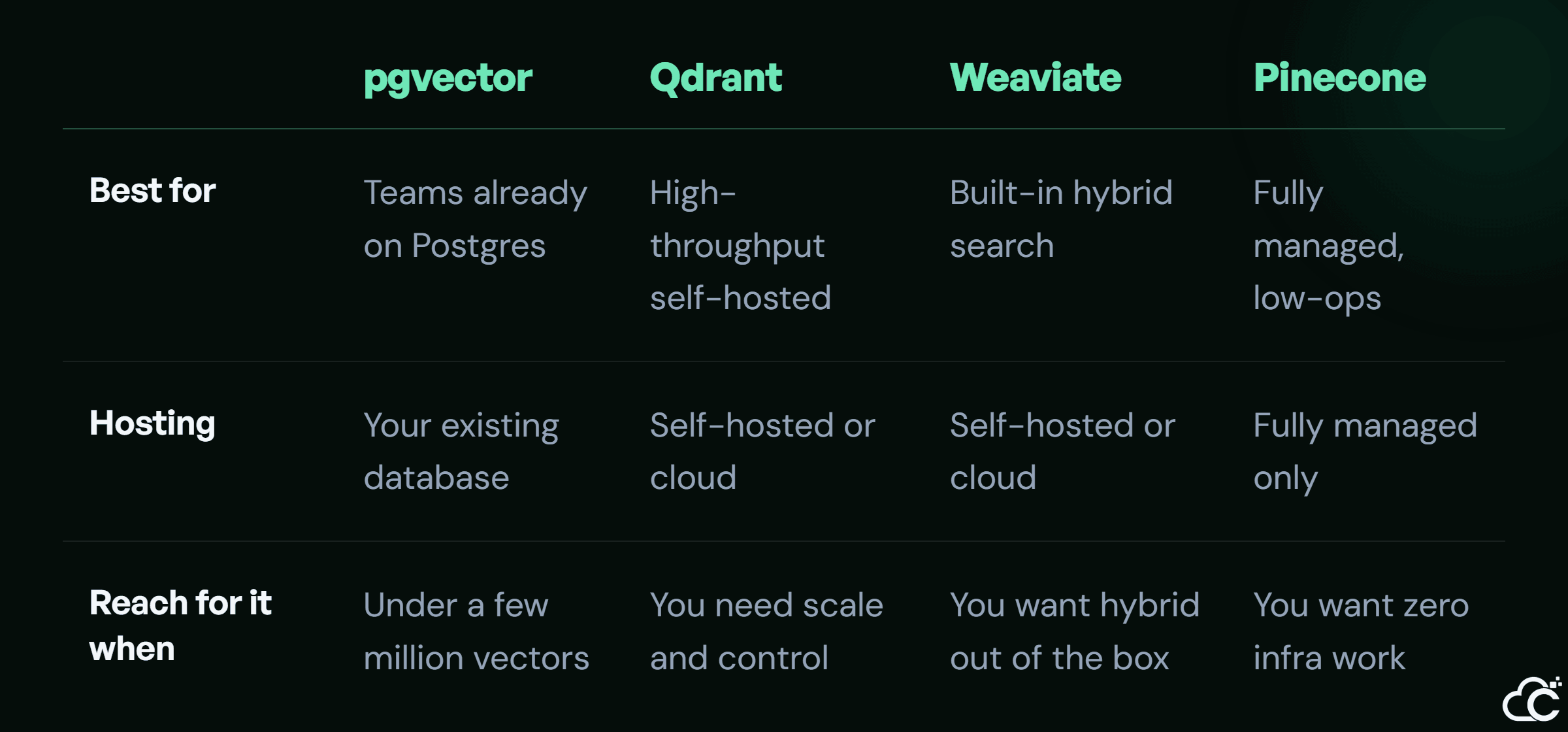
The practical rule: for most teams under a few million vectors, pgvector inside the Postgres you already run is enough, and it saves you a system to maintain. Move to a dedicated database when scale, filtering, or hybrid needs genuinely outgrow it. Pick one with native hybrid support from the start, because most production systems add hybrid search within months and retrofitting it is painful. Whichever you choose, the surrounding pipeline is where the GenAI engineering to build it right matters more than the database brand.
Stopping hallucinations: grounding and measurement
Every team wants the prompt that ends hallucinations. It doesn't exist. RAG reduces hallucinations by grounding answers in retrieved facts, but never removes them fully — and any honest system is built around that truth.
The real defense is measurement. Frameworks like RAGAS score how faithful each answer is to its retrieved context — whether the answer contains only claims the source supports — so you can track that number continuously. Two design choices help alongside it. Make the model cite the passages it used, so a person can check where an answer came from. And build it to say "I don't have enough information" when nothing relevant is found, instead of inventing an answer. This is the shift from prompt-first to eval-first: build a test set with known answers, measure faithfulness against it, and treat that score as a release gate. The goal isn't zero hallucinations. It's a number you measure, monitor, and keep improving.
When to reach for agentic and graph RAG (and when not to)
Once the basics work, the temptation is to add the advanced patterns everyone writes about. Sometimes that's right. Often it's over-engineering.
Agentic RAG lets the system reason across multiple retrieval steps, deciding what to fetch next based on what it found. Graph RAG connects information across documents through a knowledge graph. Both are powerful for complex, connect-the-dots questions spanning many sources — and both add real latency, cost, and complexity. They earn their cost on hard questions and waste it on simple lookups. Exhaust the fundamentals first: chunking, hybrid search, reranking, evaluation. Only then, if the questions genuinely need multi-step reasoning, reach for agents that reason across multiple steps . Reaching for the exotic pattern before the basics work is the most common way teams waste months.
Conclusion
Production-grade RAG in 2026 isn't about the newest technique. It's doing the unglamorous things in the right order: clean ingestion and chunking, hybrid search with reranking, a vector database sized to your real scale, and evaluation built in from day one. The teams whose systems hold up under load aren't chasing the most advanced architecture. They fixed retrieval first and measured everything. If you're trying to move your own RAG system from a promising demo to something you can trust in production, that's the work worth focusing on — and we're glad to help you get there.
.png&w=3840&q=85)