

What multi-agent orchestration actually means
A multi-agent system is several AI agents, each with its own job, working together on one larger task. Orchestration is the layer above them. It decides which agent acts, when it acts, and what information it gets.
That second part is where the real difficulty lives. Building one agent is a prompt, a model, and some tools. Building five means answering harder questions. How do they pass work between them? What happens when one fails? Who decides what comes next? And how do you see what went wrong afterwards? Frameworks exist mostly to answer those questions for you.
It's also worth separating two things people mix up. One agent that can call ten different tools is still a single-agent system. A multi-agent system means separate agents, each with its own instructions and reasoning, coordinating with each other. That difference matters, because the first is far simpler to build and debug.
Start with one agent — most teams need fewer than they think
Here's the part most guides skip. The industry has swung hard toward multi-agent designs. A lot of teams are now building them for problems that never needed them.
Adding agents doesn't add capability. It adds coordination — and coordination is where systems break.
A single well-built agent with a good set of tools handles most real tasks. Split that into five agents and you don't only gain specialisation. You inherit the cost of every handoff: more delay, more tokens, more places for an error to start, and a much harder system to debug. Start with one agent. Split it when you hit a real wall, not because a five-agent diagram looks more impressive.
When multi-agent genuinely earns its cost
There are real cases where splitting is right. They share a common shape. The work is truly separable, not just easy to describe as separate.
The clearest case is when subtasks need different tools or permissions. An agent that can read customer records shouldn't be the one that can send emails, for security reasons alone. The second is true parallel work, where independent branches run at the same time and you finish faster. The third is genuinely distinct expertise, where one agent's instructions would otherwise become a confusing mix of unrelated jobs. If your reason isn't one of those three, one agent is probably still the answer.
The three coordination patterns that work
Most working multi-agent systems use one of three shapes. Picking the right shape matters more than picking the right framework.
The pipeline is the simplest. Agents run in a fixed order, each one's output feeding the next. Use it when the steps are known ahead of time and never change. The supervisor pattern puts one agent in charge of routing. It reads the request, decides which specialist should handle it, and passes the work along. Use it when the path depends on the input. The group discussion pattern lets several agents contribute to a shared conversation, with something deciding who speaks next, until they settle on an answer. It suits problems that improve through debate. It's also the most expensive of the three, because every turn costs tokens.
Start with a pipeline if you can. Move to a supervisor when routing needs judgment. Reach for group discussion only when the back-and-forth improves the answer.
What actually breaks in production
Multi-agent systems fail in ways single agents don't, and the failures cost money. Knowing them ahead of time is most of the defence.
The most common is the runaway loop. An agent keeps calling itself, or two agents bounce work back and forth, burning tokens until something stops them. Close behind is context growth. As agents pass information along, the history grows until it quietly passes the model's limit and gets cut off. The system then behaves strangely for no visible reason. Then there's compounding error, where a small mistake in the first agent's output becomes a confident wrong answer three handoffs later. Underneath all of it, cost multiplies. Five agents discussing a problem costs many times what one agent answering it does.
Every handoff is a place where information can be lost and an error can be born. Fewer handoffs, fewer failures.
Choosing a framework: LangGraph, CrewAI, or AutoGen
Three frameworks dominate the conversation. They take genuinely different approaches, and the honest summary is that they trade control against speed of building.
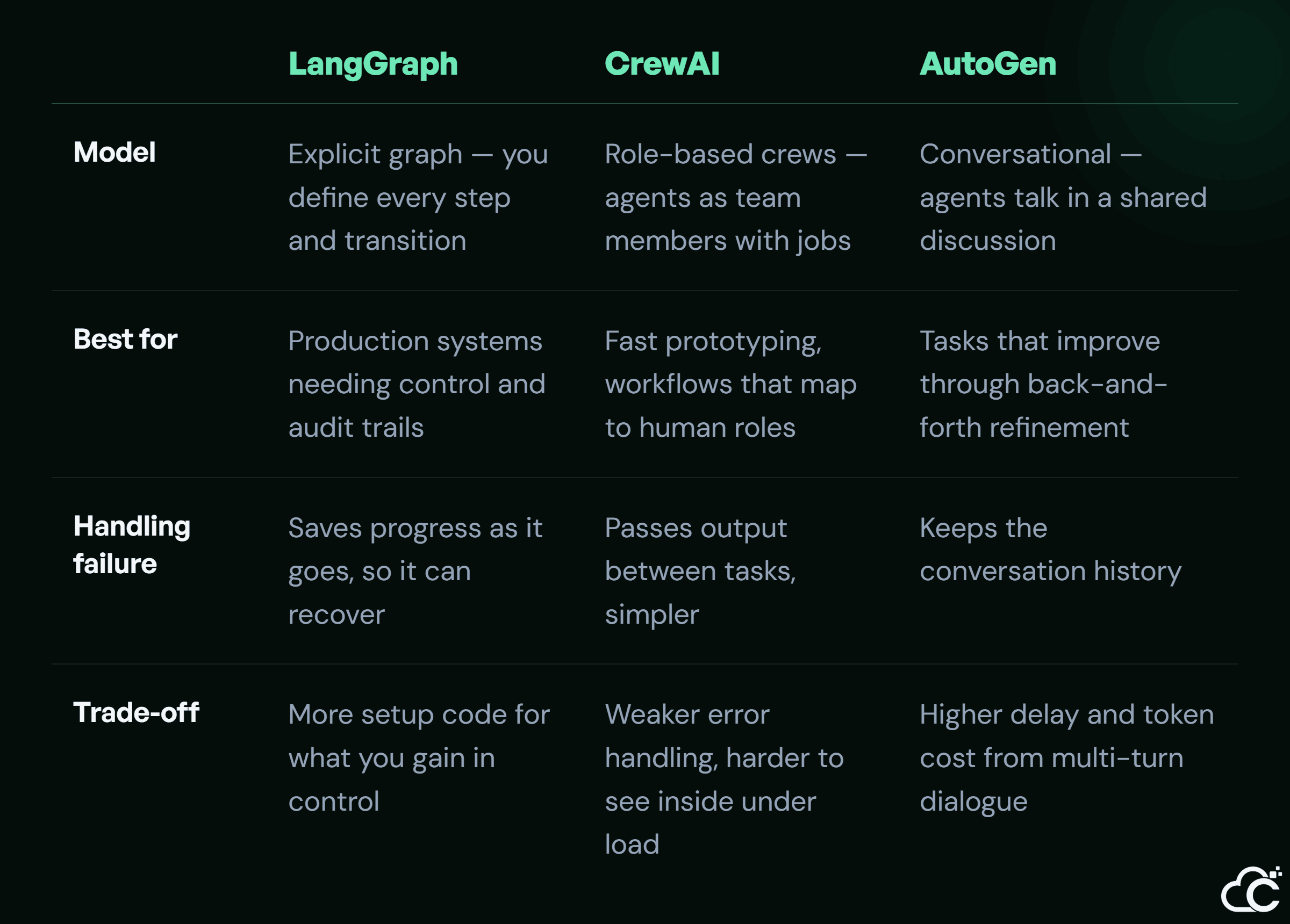
Two practical notes before you choose. Teams often start on CrewAI because it's the easiest to begin with, then move to LangGraph when they need more control over how information is stored and passed. That's worth knowing early, because switching later is expensive. Also, Microsoft has moved AutoGen into maintenance mode in favour of its newer Agent Framework, so check the current status before starting a new project on it. Whichever you pick, the framework matters less than how you build around it. The engineering to build agents that hold up in production is the harder part.
Keeping a multi-agent system debuggable
The difference between a demo and a system you can operate is whether you can see inside it. Build that in from the start, not after the first outage.
Trace every handoff, so you can replay which agent did what with which information. Set hard step limits and timeouts on every agent. That's the simplest defence against runaway loops. Give each agent access to only the tools its job needs, which limits both security risk and how much damage a mistake can do. And test each agent on its own, then test them working together, because agents that each score well can still fail badly as a group. This is unglamorous engineering. It's also most of what separates the teams building GenAI systems that survive real use from the ones stuck demoing.
Conclusion
Multi-agent orchestration is a real step forward for problems that need it. It's a costly detour for problems that don't. The teams building systems that work in production tend to do the same things. They start with one agent and split only when they hit a real wall. They choose the simplest coordination pattern that fits. And they build tracing and limits in from day one. Fewer agents, clearer coordination, and full visibility beat an impressive architecture diagram every time. Thinking through whether your own workload actually needs multiple agents is the right first step, and we're happy to work through that with you.
.png&w=3840&q=85)