

The build vs buy question most teams get wrong
Most teams treat build vs buy as one big decision. They pick a side — "we're a build company" or "we buy everything" — and apply it to every AI project that comes along. That's the first mistake.
Build vs buy isn't a company-wide policy. It's a choice you make separately for each workflow, because the right answer changes from one use case to the next. A routine support agent and a proprietary pricing engine are not the same decision, even inside the same company. The teams that get the most from AI treat each workflow on its own terms.
The question isn't whether your company should build or buy AI agents. It's whether this specific agent, for this specific job, is worth building.
Answer that well and the rest follows. Apply one fixed rule to everything, and you either build things you could have bought, or buy things you needed to own.
Why buying wins for most use cases
Start with the honest answer: for most needs, buying is the right choice. That's true even though we build custom agents for a living, and we'd rather say so plainly.
Buying an existing platform gets you running in weeks instead of months. The upfront cost is lower, the security and compliance work is already done, and the vendor handles maintenance and updates. For a common, well-defined need, such as a support assistant, a meeting summarizer, or a standard sales helper, a platform built for that job will usually beat a custom build on cost, speed, and reliability. The market is full of solid products for common problems, and rebuilding one of them from scratch rarely pays off. If your need looks like something many other companies also have, buying is almost always the smart first move.
When building actually wins
Building is the right call in specific situations, not as a default. The honest test is whether the agent does something a bought product genuinely can't.
There are four conditions where building pays off. The first is real differentiation. If the agent is part of what makes your business better than your competitors, using the same vendor tool everyone else uses removes that edge. The second is deep integration: the agent has to work so closely with your own systems and data that no off-the-shelf product can reach. The third is genuinely regulated or sensitive data that must stay under your control for compliance reasons. The fourth is scale: at very high volume, the running cost of a custom build can drop below what a per-use platform charges. If one of those four is true, custom agent development that fits your exact workflow is worth the investment. If none of them is true, you're probably better off buying.
One honest caution before you commit to building: it's harder than most teams expect. Independent research by RAND found that more than 80% of AI projects fail to reach production, twice the failure rate of regular IT projects that don't involve AI. Building is a real commitment, not a default, and that failure rate is the reason to reserve it for cases that truly need it.
Build vs buy: the decision factors side by side
The trade-offs become clearer when you see them next to each other. Here's how the two paths compare on the factors that matter most.
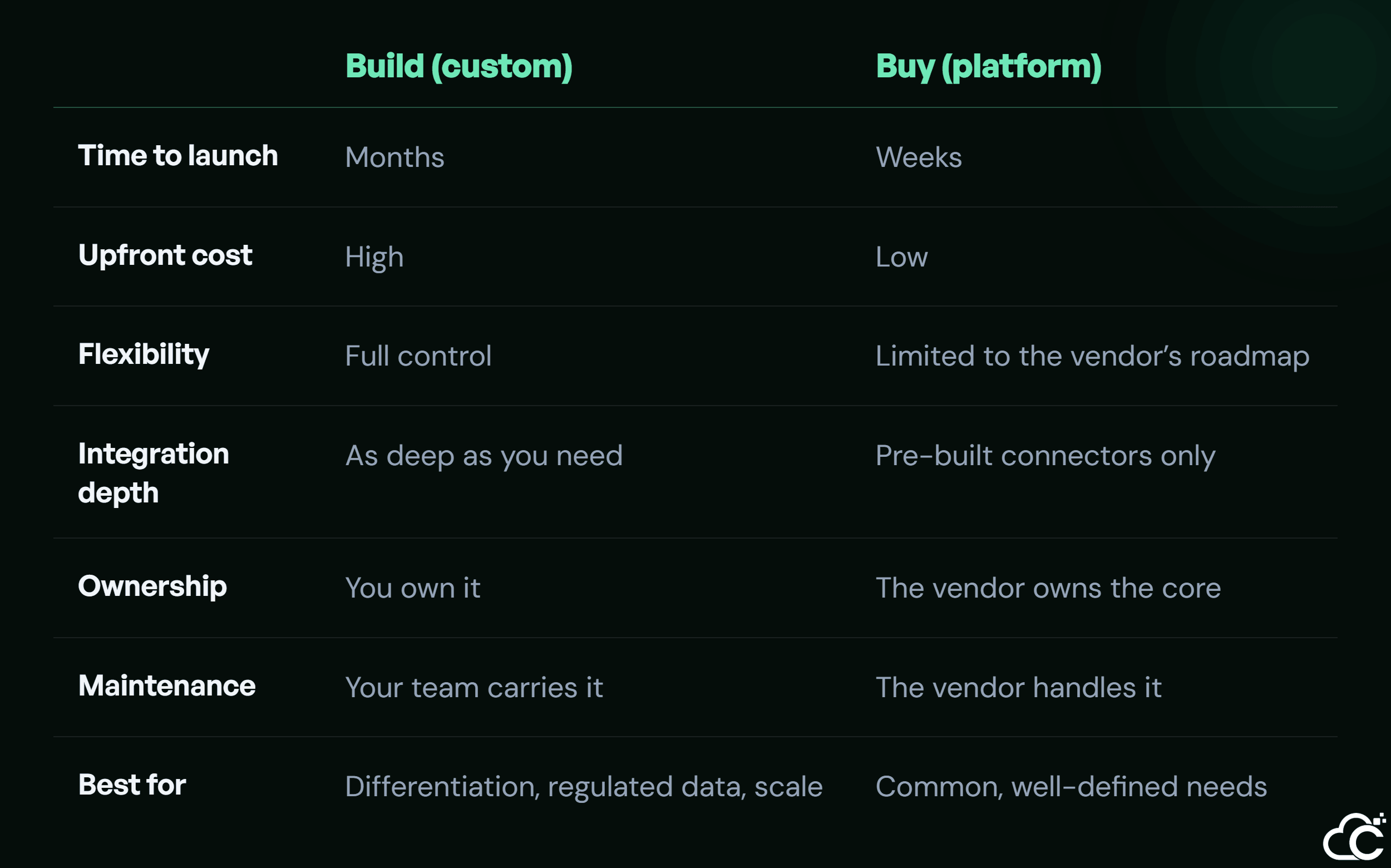
Read down the two columns and the pattern is clear. Buying trades control for speed and low upfront cost. Building trades speed and simplicity for control and ownership. Neither is better in the abstract — they fit different jobs.
The cost most teams underestimate: maintenance
Here's the number that changes the decision, and almost every first-time build gets it wrong. The cost of a custom agent isn't mostly in building it. It's in keeping it running.
Building the agent is the small part. Maintaining it, most of the ongoing cost, is where the real spending lives.
Across the industry, the majority of a custom agent's three-year cost comes after launch, not during the build. Models need updating. Prompts need tuning as the business changes. Integrations break when the systems they connect to change. Monitoring, security, and fixes never stop. Teams that budget only for the initial build routinely underestimate the true cost by a wide margin, because they priced the prototype and forgot the years of upkeep behind it. When you compare building to buying, compare the full multi-year cost of ownership, not just the price of getting to a first version. A build that looked cheaper than a subscription often isn't, once the maintenance years are counted.
The answer is usually hybrid
In practice, the smartest answer is rarely pure build or pure buy. It's both, matched to where each one is strong.
Most successful teams buy the foundation and build the part that sets them apart. They use ready-made models and platforms for the standard parts, then build their own logic on top for the part that's truly unique to them. This gives them speed and low cost where the work is standard, and control and ownership where it matters. It also avoids the two failure modes: buying everything and getting trapped by a platform's limits, or building everything and wasting months rebuilding parts a vendor already does well. Working out a clear plan for what to build and what to buy across your workflows is usually more valuable than any single build-or-buy verdict.
How to actually decide (the framework)
To turn this into a decision you can defend, score each workflow on five questions. This is the framework to apply per use case, not once for the whole company.
First, differentiation: does this agent make your business meaningfully better than competitors, or is it a common need? Second, data sensitivity: does it handle regulated data that must stay under your control? Third, integration depth: does it need to reach deep into your own systems, or will standard connectors do? Fourth, volume: is it high enough that custom economics beat per-use pricing? Fifth, capacity: does your team actually have the engineering strength to build and maintain it? Lean toward building when differentiation, sensitivity, integration, or volume is high and your team can support it. Lean toward buying when the need is common and your engineering capacity is limited. Run this for each workflow and the answer usually becomes clear.
Conclusion
Build vs buy for AI agents isn't a single decision you make once. It's a judgment you apply workflow by workflow, and for most workflows, buying is the honest right answer: faster, cheaper upfront, and lower risk. Building earns its place when the agent truly differentiates you, handles regulated data, demands deep integration, or runs at a scale where the economics flip. Above all, remember that the real cost of building lives in the maintenance years, not the first version, and that most strong deployments end up hybrid. If you want help working out which of your workflows are worth building and which are better bought, that's a conversation we're glad to have.
.png&w=3840&q=85)