

Why legacy application modernization is so hard
Every large company runs on software that's older than it would like to admit. It handles important work, it costs a lot to maintain, and it's very hard to change quickly. The people who built it have often left, and no one wrote down how it works. This is the problem legacy application modernization sets out to fix. For years it stayed painful for one reason: figuring out what the old code did cost more than simply rewriting it.
AI agents have genuinely changed that. They can read old code, show how it all connects, and explain what it does far faster than a person working by hand. But this is exactly where the hype runs ahead of reality, and where an honest look helps.
Legacy modernization was never really a technical problem. It's a business problem: the cost, the change to how teams work, and the risk of getting it wrong.
AI helps most with the technical part, which was rarely the hardest part. So the real question isn't "can AI modernize our systems?" It's "which parts of the work should AI do, and which parts still need a person?"
Where AI agents genuinely help
There are clear stages of the work where AI agents save real time and money. They happen to be the stages that were always the most expensive, so the value here is real, not promised.
The first is understanding the old code. An AI agent can read through a large, old system and work out what each part does, turning months of manual reading into days. The second is mapping how things connect. The agent traces how one part of the system depends on another, showing the hidden links that usually cause problems late in a project. The third is writing the documentation, explaining in plain language what the code actually does. This is the work most teams skip because there's never time for it. The fourth is creating tests, the safety checks that let you change the system without breaking it. These four stages are the costly early work, and McKinsey found that AI can make modernization timelines 40 to 50 percent faster, mostly right here.
Where humans still have to decide
Knowing where AI should not be in charge matters just as much. These are the choices that carry real business risk, and handing them to an agent is how projects go wrong.
The first is designing the new system. Deciding what the modern version should look like, how it should be built, and what it should connect to is a choice about the future of the business, not a simple code translation. The second is checking that the new system is correct. An agent can turn old code into new code, but a person has to confirm the new version still does exactly what the business needs, because one small difference can cost money or break a rule you have to follow. The third is deciding when to switch over. Moving from the old system to the new one, and choosing when and how, is a risk decision that belongs to people who understand what's at stake. AI does the heavy lifting. People review and decide.
AI-assisted vs traditional modernization
The difference AI makes is easiest to see when you put the stages side by side. Here's roughly how the work changes.
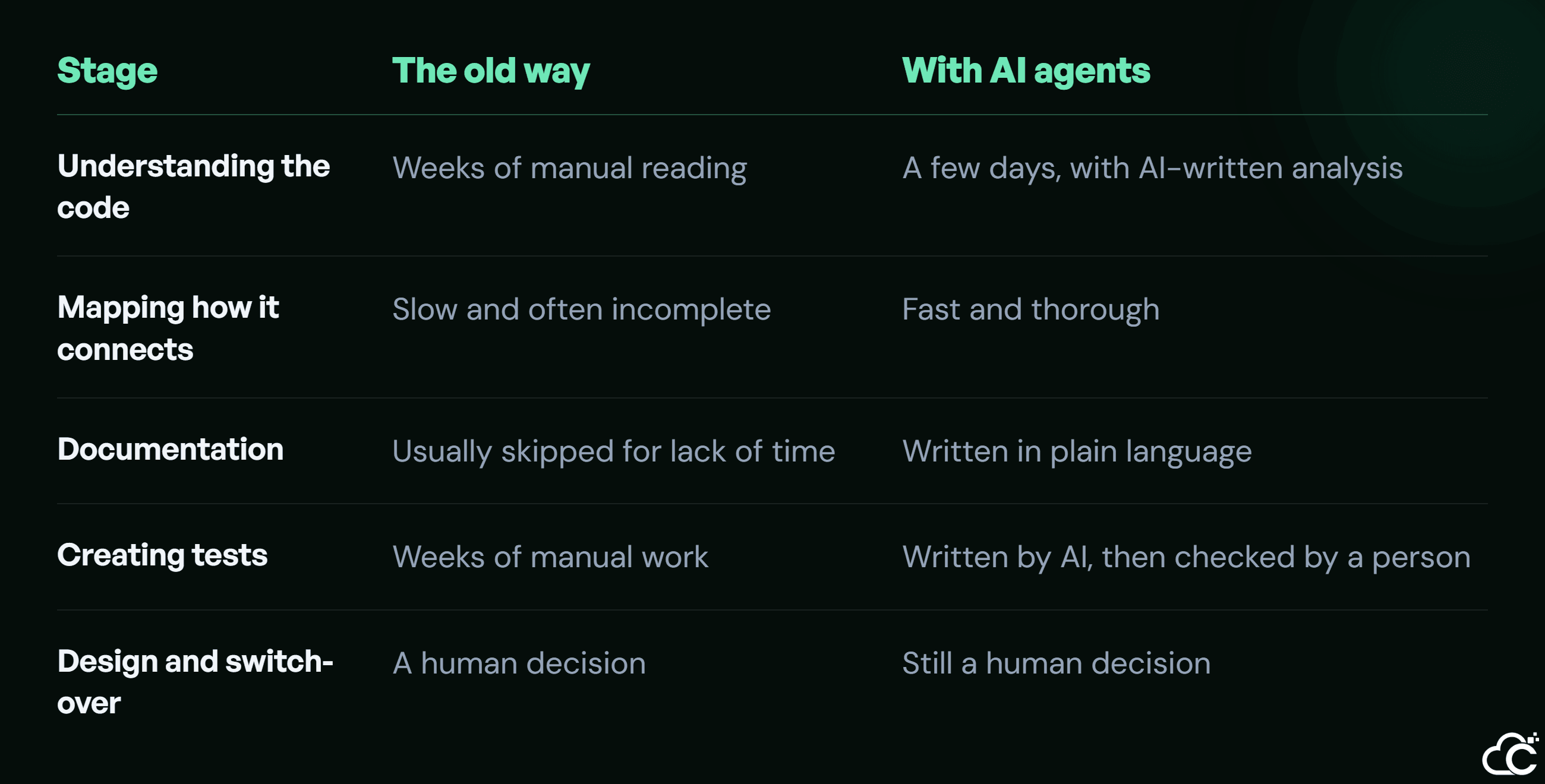
Read down the table and the pattern is clear. AI makes the understanding and preparation work much faster, while the decisions that carry business risk stay exactly where they were, with people. The time saved is real, and it lands in the stages that used to make modernization too expensive to even start.
Why replacing everything at once still fails
Now that AI makes the work faster, it's tempting to try replacing the whole system in one go. That's a trap, and it's the same one that sank these projects before AI came along.
Replacing the entire old system in a single launch puts all the risk in one moment. If something breaks, everything breaks together. The approach that works is to do it in steps: update the old system one piece at a time, keeping the rest running, so each change is small and easy to undo if needed. A common way to do this is to put a modern layer around the old system, then retire its pieces one by one as new parts prove they work. AI makes each of these steps faster, but doing it in stages is what keeps the risk under control. Getting this order right is the heart of planning a modernization the right way , and it matters more than how fast any single step goes.
The cost and timeline truth
The savings from using AI are real, but they come with honest limits worth saying plainly. Overselling them is how projects end up promising more than they can deliver.
AI can cut both the timeline and the cost, mainly by making the understanding and documentation stages affordable for the first time. But checking and testing the new system still takes a large share of the effort, and AI speeds that part up the least, because a person still has to confirm the new system behaves correctly. For a large system, a realistic program still runs for many months, not weeks. What AI changes is that each stage runs faster and several can run at the same time, not that the whole thing becomes instant. As McKinsey noted, the value comes less from the AI itself and more from how it's used, which is why an application modernization strategy that pairs AI with human judgment beats one that expects AI to do everything.
How to start without over-committing
The safe way to begin is small and based on evidence, the same as any high-stakes project. You don't bet the whole company on the first move.
Pick one old application that costs you the most to maintain, or that holds back the most work. Use AI agents to understand it, map how it connects, and write its documentation. This gives you a clear, low-risk picture of what you're dealing with before you commit to a full program. Have your own experts check that picture. Then update one piece, prove it works, and grow from there. This step-by-step path is where the engineering to modernize an application properly pays off, because it turns an overwhelming multi-year problem into a series of small, provable steps.
Conclusion
Legacy application modernization in 2026 is genuinely faster and cheaper than it used to be, because AI agents now handle the expensive early work of understanding old code. But the honest picture is a partnership, not a handover. AI speeds up understanding, mapping, documentation, and testing, while people keep control of the design, the correctness checks, and the switch-over. The projects that succeed still move one step at a time, still treat testing as the real bottleneck, and still check the business case instead of trusting the hype. If you want help working out where AI agents fit in your own modernization, and where your team should stay in control, that's a conversation we're glad to have.
.png&w=3840&q=85)