

Why GenAI projects fail on the data, not the model
When a GenAI project underperforms, the first instinct is to blame the model. Teams swap to a bigger model, tune the prompt, and wait for the results to improve. They usually don't, because the problem was never the model.
The problem is the data feeding it. An agent can only reason over what it retrieves, and if the pipeline hands it stale, incomplete, or poorly structured data, it produces confident answers built on bad inputs. The line that sums up the whole field is simple.
Retrieval quality is a data problem before it is a model problem. Fix the pipeline, and most of the model's mistakes disappear.
This is why data engineering has quietly become the deciding factor in whether GenAI works, and data engineering for AI goes well beyond traditional ETL. The model gets the attention. The data layer does the work.
How AI pipelines differ from classic data pipelines
If you've built data pipelines for years, the instinct is to treat AI as one more consumer of the same tables. It isn't. What an AI system needs from your data is different enough to change the job.
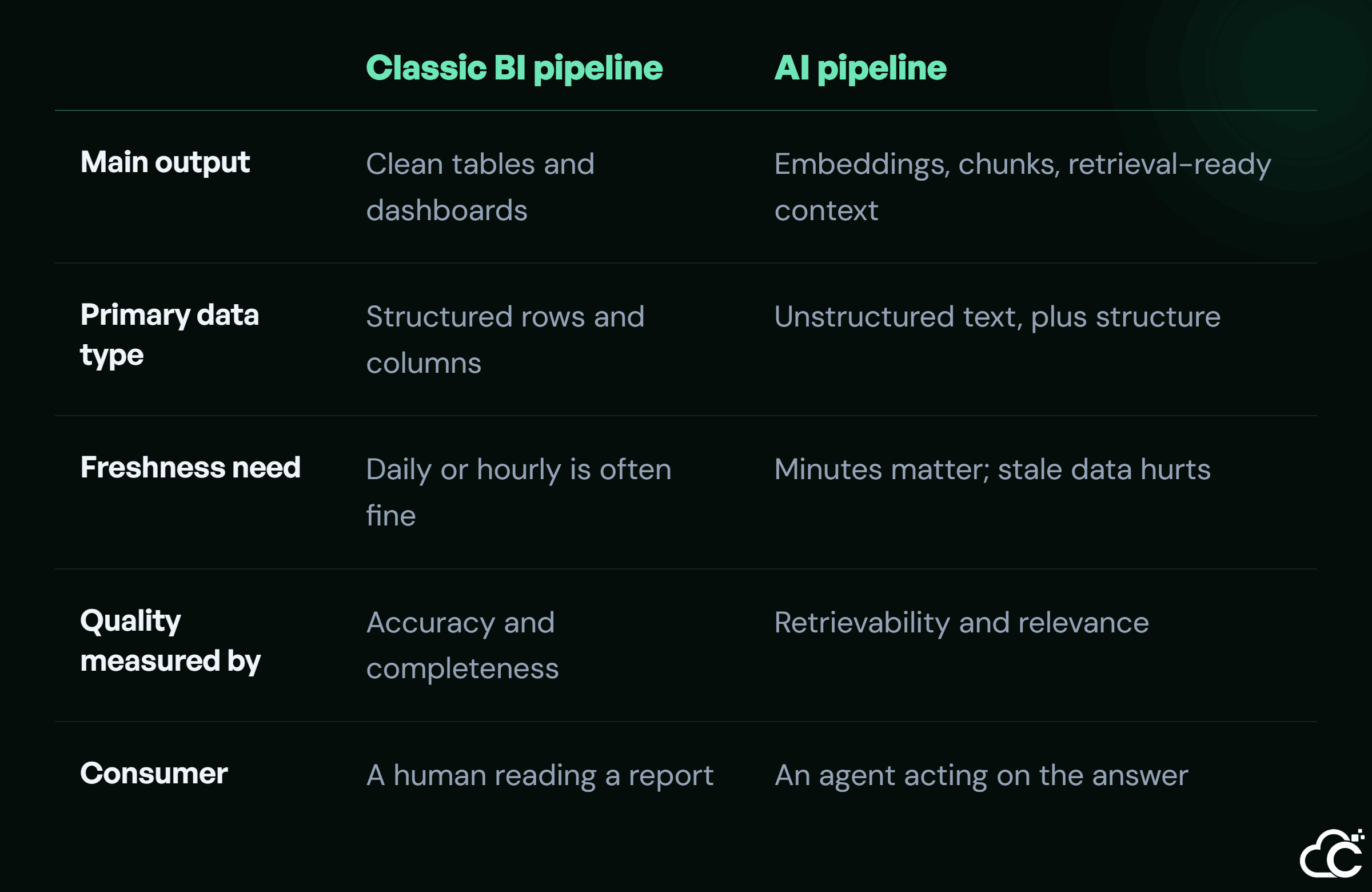
The pattern is clear. A classic pipeline exists to produce reports a person reads. An AI pipeline exists to feed a system that acts. That change in who uses the data affects everything that follows. The next three sections show where it matters most.
Why stale data quietly breaks AI answers
In classic reporting, data that's a day old is usually fine. A dashboard showing yesterday's numbers still does its job. AI breaks that assumption.
When an agent retrieves stale data, it doesn't fail loudly. It answers confidently with the wrong context.
If your embeddings were built from last week's documents and the documents have changed, the agent retrieves outdated context and presents it as current fact. There's no error message. The answer just becomes wrong. This is why AI pipelines push toward near-real-time updates for the data that changes often, and why "how fresh is this embedding" becomes a question you have to answer. Freshness stops being a nice-to-have and becomes a correctness requirement.
Unstructured data moves from edge case to main event
Classic data engineering treats structured data as the main job and unstructured files as a side problem. AI flips that. Most of what an agent needs to know lives in documents, tickets, emails, and PDFs, not in tidy tables.
That changes the pipeline's work. You now have to ingest messy documents, clean them, and split them into passages small enough to retrieve but coherent enough to make sense. That splitting step, called chunking, decides retrieval quality more than almost anything else. Split documents badly and the agent pulls back fragments that don't make sense. Get it right and retrieval sharpens. The extraction and structuring of this messy data is what makes it usable by the GenAI systems that consume it , and it's real engineering, not a preprocessing afterthought.
Lineage, metadata, and trust for agents
When a person reads a report, they apply judgment to what they see. When an agent acts on data, it doesn't. That raises the bar for knowing where data came from and what it means.
Lineage — the record of where each piece of data originated and how it was transformed — moves from a governance checkbox to an operational need. If an agent gives a wrong answer, you have to trace which data led it there, and you can't do that without lineage. Metadata matters more too. Clear descriptions of what each field and dataset actually means give both your team and the model the context to use the data correctly. In an AI system, undocumented data isn't just inconvenient. It's a source of quiet errors nobody can trace.
You don't rebuild — you extend
Here's the reassuring part, because all of this can sound like a lot. You don't need to tear down your data stack and start over. The right move is to extend what you already run.
The practical path is incremental. Audit your most important tables and add clear descriptions where they're missing.Turn on lineage tracking — tools like dbt generate it automatically . Pick one pipeline and make it vector-ready by adding an embedding step as a separate job, without touching what already works. Add a validation checkpoint that catches bad data before it reaches production. None of these steps requires a rebuild, and each one moves you toward a data foundation built for AI without breaking what your business already depends on.
Where this runs: the cloud cost angle
One honest note for whoever owns the budget. AI data workloads change your cloud costs, and it's worth planning for before the bill arrives.
Embeddings, frequent reprocessing, and vector storage all consume more compute and storage than a classic reporting pipeline. Reprocessing a large document set into embeddings isn't free, and vector data grows fast. This is where storage tiering — keeping hot data fast and cold data cheap — and general cost discipline matter. Building AI-ready data without keeping those cloud costs under control is how teams end up with a working system and a budget surprise.
Conclusion
Data engineering is the part of GenAI that decides whether the rest works. The model gets the headlines, but the pipeline underneath it determines whether an agent retrieves the right context or confidently serves the wrong one. The teams whose AI works in production tend to share the same habits. They treat freshness as a correctness issue, they make unstructured data a first-class input, they keep lineage so mistakes can be traced, and they extend their existing stack rather than rebuilding it. Working out what your own data layer needs to become AI-ready is the right place to start, and we're glad to help you map it.